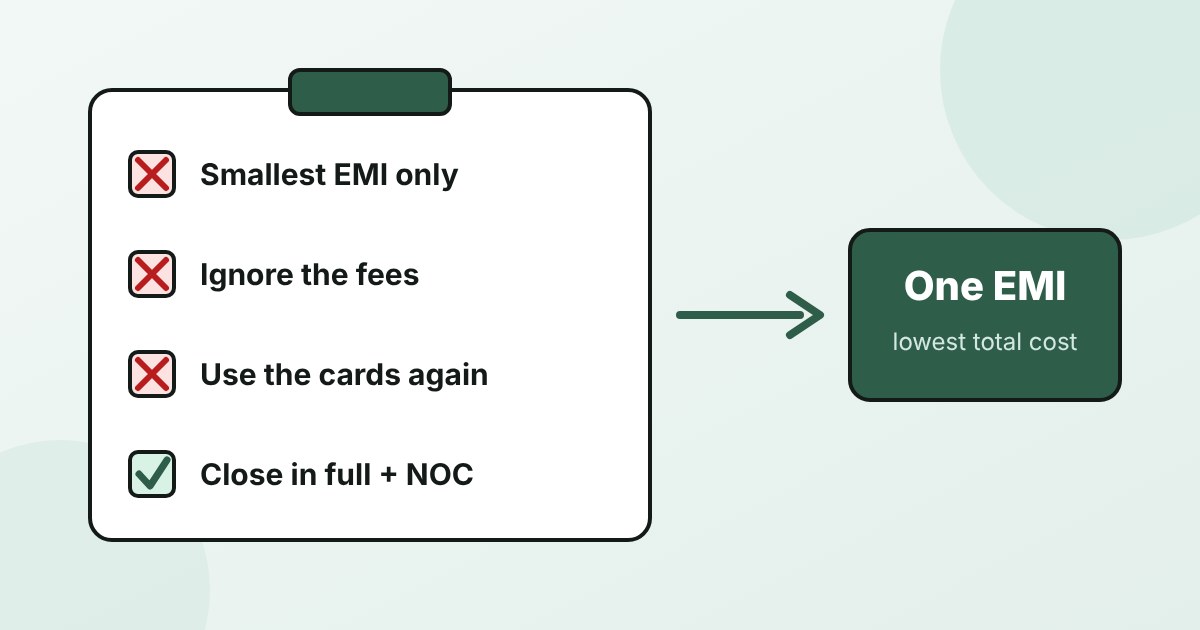
Short answer: the debt consolidation mistakes that cost the most are (1) picking the longest tenure just for a small EMI, (2) forgetting the processing fee and the foreclosure charges on the old loans, (3) leaving the most expensive debt out, and (4) spending on the cards again after they are cleared. Compare offers on the annual percentage rate (APR) in the Key Facts Statement, close every old loan in full, and collect a closure letter for each.
Debt consolidation means taking one new loan to close several older ones, so you pay one EMI instead of five. Done well, it lowers your interest and makes the month easier to manage. Done badly, you pay more in total and end up with the new loan and the old debts. Here are nine mistakes, with what each one costs.
1. Choosing the smallest EMI instead of the lowest total cost
A longer tenure gives a smaller EMI, but you pay interest for more months. This is the most common way consolidation ends up costing more than it should.
Worked example (assumed numbers, not a customer's case). Rahul takes home ₹60,000 a month and owes ₹3,00,000 across two cards, two app loans and a personal loan. A lender offers a ₹3,00,000 consolidation loan at 13% a year (an assumption inside ICICI Bank's published range of 10.25% to 16.50%, checked 15 November 2026; the lender decides your rate).
| Tenure | EMI | Total interest |
|---|---|---|
| 3 years (36 EMIs) | ₹10,108 | ₹63,895 |
| 5 years (60 EMIs) | ₹6,826 | ₹1,09,555 |
The 5-year option saves ₹3,282 a month but costs ₹45,660 more in interest. EMI = P × r × (1 + r)^n ÷ ((1 + r)^n − 1), with P = ₹3,00,000, r = 13% ÷ 12 and n = months.
What to do: choose the shortest tenure whose EMI you can pay every month, even in a bad month. If you pick the longer one for safety, plan to prepay with a bonus or increment, and check the part-payment charge first (ICICI Bank lists 3%, nil after 24 EMIs, checked 15 November 2026).
2. Forgetting the charges on both sides
Two sets of charges sit around every consolidation:
- The new loan's processing fee. ICICI Bank lists up to 2% of the loan amount plus taxes. On ₹3,00,000 that is up to ₹6,000, or ₹7,080 with GST at 18%.
- The old loans' foreclosure charges. HDFC Bank lists 4% of the principal outstanding up to 24 EMIs, 3% from 24 to 36 EMIs and 2% after that. Closing a ₹1,20,000 HDFC Bank personal loan in its first two years costs ₹4,800, or ₹5,664 with GST.
In Rahul's case that is about ₹12,744 before he saves anything. If the lender takes the processing fee out of the amount it pays out, the new loan may fall short of what he needs to close everything.
RBI's Pre-payment Charges on Loans Directions, 2025 bar foreclosure charges on floating-rate loans to individuals for non-business purposes sanctioned or renewed from 1 January 2026. Most personal loans and app loans are fixed-rate, so their own terms decide. Read the sanction letter or Key Facts Statement of each old loan before you apply.
3. Comparing headline rates instead of the APR
A low headline rate with a high fee can cost more than a slightly higher rate with no fee. The number to compare is the annual percentage rate (APR), which includes the fee and other charges.
RBI's Digital Lending Directions, 2025 require digital loan offers to show the APR, amount, tenure and monthly repayment so borrowers can compare them, and every regulated lender must give you a Key Facts Statement (KFS) before you sign. Ask each lender for its KFS and compare the APR line by line.
4. Leaving the most expensive debt out
Some borrowers consolidate the personal loan they find easiest to move and leave the credit card or the app loans running. That is backwards. Cards often charge the most: Federal Bank's card terms list finance charges of up to 3.75% a month (45% a year). Payday and app loans can cost far more, as our article on why you should never take a payday loan shows.
List every debt with its rate and close the costliest first. If only one costly personal loan is the problem and you have no card or app dues, a personal loan balance transfer may be simpler than a full consolidation.
5. Running the cards up again
After a consolidation loan clears your cards, the limits are free again. If ₹1,20,000 goes back on them, at 3.75% a month that is ₹4,500 of interest a month, ₹5,310 with GST, on top of the new EMI. Now you have two problems instead of one.
Keep older cards open at zero if you can resist using them, because closed cards remove their limit from your record. If you cannot, lower the limit or close the newest card. Our credit card minimum due article shows how fast a carried balance grows.
6. Applying to many lenders at once
Every application lets the lender check your credit report, and TransUnion CIBIL says several enquiries in a short period may affect your score. Rejections then push people to apply to more apps, which makes the next approval harder. Shortlist one or two lenders that fit your income and existing EMIs. Our article on whether debt consolidation hurts your CIBIL score explains what each step does to your report.
7. Treating settlement as consolidation
A "debt relief" offer that gets a lender to accept less than you owe is a settlement, not a consolidation. The account shows as settled on your credit report, and later lenders read that as a loss. Consolidation pays every old loan in full, so the accounts show as closed. If you can still pay in full, consolidate. Read settled vs closed on your CIBIL report before you sign anything that reduces what you owe.
Also check who the lender is. Under RBI's Digital Lending Directions, a lending service provider's fees are paid by the regulated lender and are not charged to or collected from the borrower separately.
8. Not collecting closure letters or checking your report
Paying an old loan off is not the end. Get a closure letter or No Objection Certificate (NOC) from every lender and app, and check your credit report after the next reporting date. Since 1 July 2026, RBI requires lenders to report to the bureaus as on the 9th, 16th, 23rd and last day of each month, so a closed loan should show within about two weeks of the lender updating its books. Our guide to how often your CIBIL report is updated explains what to do if it does not.
9. Putting your home at risk without a plan
A home loan top-up or a loan against property can clear unsecured debt at a lower rate, but your house or flat becomes the security. If you miss EMIs, the lender can enforce that security. These loans can run for many years, so a lower rate can still mean more total interest, and processing, valuation and legal charges apply. Use them only with a steady income and an EMI you can carry for years.
A checklist before you consolidate
- List every debt: outstanding, EMI or card due, rate and foreclosure charge. The Can I merge my loans? checker does the sum and shows one EMI over 3 and 5 years.
- Check your own credit report first (checking your own score does not affect it).
- Ask one or two lenders for a KFS and compare the APR, not the headline rate.
- Choose the shortest tenure you can afford and plan prepayments.
- Close every old loan in full, collect each NOC, and keep the cards at zero.
How AdvanceCred can help
AdvanceCred is a Mumbai-based credit advisory and loan intermediation firm, not a lender. An advisor lists your loans, cards and income with you, works out the charges, and approaches the partner banks and NBFCs most likely to fit, so you do not apply everywhere yourself. AdvanceCred works on cases with up to 1 payday loan, up to 5 app loans and personal loans in total, and up to 5 credit cards. The lender decides approval, amount, rate and tenure.
See how it works on merging multiple EMIs into one, the debt consolidation loan page or payday loan consolidation, or ask for a call back.
Sources
- ICICI Bank, Personal Loan interest rates (10.25% to 16.50% p.a.; mean 11.60% for July to September 2026; processing fee up to 2% plus taxes; foreclosure 3% of principal outstanding, nil after 24 EMIs; part-payment 3%, nil after 24 EMIs), checked 15 November 2026.
- HDFC Bank, Personal Loan interest rates and charges (salaried 10.25% to 24.00%; processing fee up to ₹6,500 plus GST; pre-closure 4% of principal outstanding up to 24 EMIs, 3% after 24 and up to 36 EMIs, 2% after 36 EMIs; taxes extra), checked 15 November 2026.
- Reserve Bank of India, Digital Lending Directions, 2025 (loan offers to show APR, amount, tenure and monthly repayment; Key Fact Statement; lending service provider fees not charged to or collected from borrowers), checked 15 November 2026.
- Reserve Bank of India, Pre-payment Charges on Loans Directions, 2025 (no pre-payment charges on floating-rate loans to individuals for non-business purposes sanctioned or renewed from 1 January 2026), checked 14 November 2026.
- Reserve Bank of India, Credit Information Companies (Amendment) Directions, 2025 (credit information as on the 9th, 16th, 23rd and last day of each month from 1 July 2026), checked 8 November 2026.
- Federal Bank, Credit cards Most Important Terms and Conditions (finance charges up to 3.75% a month), and IndusInd Bank, GST on credit cards (18% on interest and fees), checked 4 November 2026.
- TransUnion CIBIL, Understanding your CIBIL score and report (multiple enquiries in a short period may impact your score; checking your own score does not; keep older accounts open), checked 13 November 2026.
EMIs and interest in the worked example use the standard reducing-balance formula; the 13% rate, the ₹1,20,000 HDFC Bank loan and GST at 18% on fees are assumptions for illustration. This article is general information, not financial advice or an offer of credit.