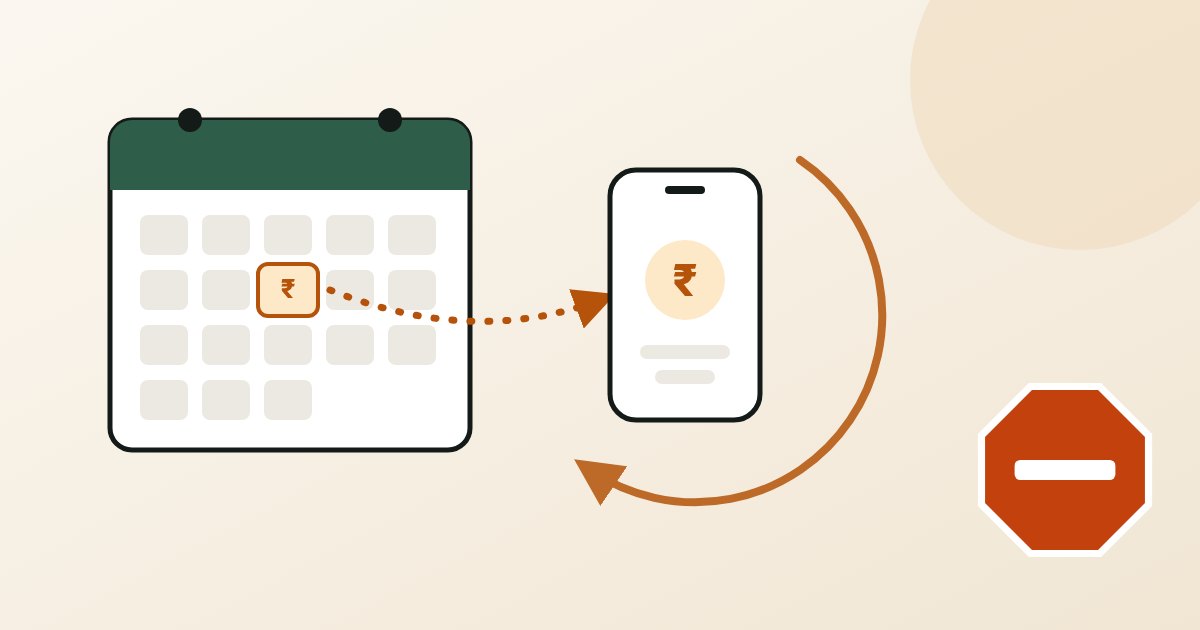
Short answer: a payday loan is repaid in one go from your next salary, usually within 7 to 60 days. The fees look small, but as a yearly rate they are among the most expensive ways to borrow. And because the whole amount leaves your account on payday, most borrowers are short again a few days later and borrow again. If you need money before payday, ask your employer for a salary advance, use a card EMI, or take one bank loan with an EMI you can afford.
This article is part of our series on getting out of multiple loans. If you already have several app loans, read how app loans drain a salary and the six warning signs as well.
What is a payday loan?
A payday loan is a small, short-term loan meant to tide you over until your salary arrives. Tata Capital describes repayment tenures of 7 days to 60 days, sometimes up to 90 days, and amounts based on a portion of your monthly salary. Unlike a personal loan, you do not repay it in EMIs: the full amount plus interest and fees is due in one payment, usually on or just after payday.
That single payment is what makes it different from an app loan with monthly EMIs, and it is the root of the problem.
Why a payday loan leaves you short again
Here is the cycle in numbers. The salary and loan are an example; the charges are an assumption for illustration, so replace them with the figures on your own loan's Key Fact Statement.
| Step | What happens |
|---|---|
| 20th of the month | Take-home salary is ₹35,000. Money runs out, so you borrow ₹15,000 until payday. |
| Payday (1st) | ₹15,000 plus, say, ₹1,500 of charges is due at once: ₹16,500 leaves your account. |
| Left for the month | ₹35,000 minus ₹16,500 = ₹18,500 for a month that cost ₹35,000 last time. |
| Around the 15th | You are about ₹16,500 short, so you borrow again, this time a bigger amount. |
Nothing in this cycle reduces your debt. Each month the loan is repaid and taken again, and the charges are paid again. If anything else goes wrong (a medical bill, a late salary), the next loan is bigger, or it comes from a second app.
How expensive is a payday loan really?
Short loans hide their cost because the charge is quoted for days or a month, not a year. To compare it with a bank loan, turn it into a yearly rate:
Yearly cost ≈ (total charges ÷ amount borrowed) × (365 ÷ number of days)
In the example above, ₹1,500 on ₹15,000 for 30 days is 10% for one month, which works out to about 122% a year (10% × 365 ÷ 30). For comparison, ICICI Bank publishes personal loan rates of 9.99% to 16.50% a year (checked 1 November 2026). At ICICI Bank's mean rate of 11.60%, one month's interest on ₹15,000 is about ₹145, not ₹1,500.
You do not have to calculate this yourself if the lender is regulated. RBI requires banks and NBFCs to give you a Key Fact Statement showing the annual percentage rate (APR), which adds interest and all charges together. If an app will not show you a KFS with an APR before you accept, do not take the loan.
Five reasons to say no to a payday loan
- It takes your whole salary's worth of breathing room. The full amount plus charges is due at once, which is why most borrowers end up borrowing again (see the table above).
- The yearly cost is very high. Fees that look like a few hundred rupees can work out to more than 100% a year when you annualise them.
- Late payment gets expensive fast. Late fees and penalty interest can apply as soon as the due date passes (check the KFS for the exact charges), and the loan is due within days, not months.
- It can hurt the loan you actually need. Regulated lenders report loans to credit bureaus, and since 1 January 2025 RBI has required reporting every fortnight. A late payday repayment, or several short loans taken close together, can show up on your report when you later apply for a bigger, cheaper loan.
- Many lending apps are not legal lenders. An RBI working group found about 1,100 lending apps available to Indian Android users between January and February 2021, of which about 600 were illegal. RBI's Sachet portal received about 2,562 complaints against digital lending apps from January 2020 to March 2021.
How to check if a loan app is legal
RBI's Digital Lending Directions, 2025 set clear rules for regulated lenders and their apps. Before you borrow, check that:
- The real lender is named. The app must tell you which RBI-regulated bank or NBFC is giving the loan. You can look the app up in RBI's public list on its website, under Citizen's Corner, "DLAs deployed by Regulated Entities".
- The money comes to your own bank account, and repayments go directly to the lender's bank account, not to a third party.
- The app does not ask for your contacts, call logs, photos or files. The Directions tell lenders to stay away from these (a one-time camera, microphone or location access for KYC, with your consent, is allowed).
- You get a Key Fact Statement with the APR, and a cooling-off period of at least one day in which you can exit the loan by paying back the principal and the proportionate APR.
- Your credit limit is not increased automatically. The Directions allow an increase only on your explicit request.
If an app breaks these rules or its agents harass you, complain to the lender first, then on RBI's complaint portal (cms.rbi.org.in). Report an app that is not linked to any regulated lender on the Sachet portal (sachet.rbi.org.in), and report threats or misuse of your data on cybercrime.gov.in.
Safer options when money runs short before payday
| Option | Why it is safer | What to check |
|---|---|---|
| Salary advance from your employer | Usually adjusted against your next salaries, often in parts | Your company's HR policy |
| Credit card EMI on a specific purchase or bill | Repaid in monthly instalments, not in one go | The rate and processing fee in your card's KFS |
| One bank personal loan | Published rates from 9.99% a year at ICICI Bank and HDFC Bank; EMIs over 1 to 7 years | Bank minimums (ICICI Bank starts at ₹50,000), your FOIR, the KFS |
| Talking to the lender of an existing EMI | A short delay agreed in advance is better than a missed payment | Ask for it in writing |
The best option depends on why you are short. If it happens every month, the problem is the size of your existing EMIs, not a one-off gap, and a short loan will not fix it. That is the point to look at merging what you already owe into one EMI that fits your salary. Try your numbers on the loan consolidation calculator.
Already have a payday loan?
- Do not take a second one to repay the first. That is how one payday loan becomes three app loans.
- Repay it on time if you can, and keep proof of payment and the closure message.
- If you also have app loans or card dues, see how to pay off multiple payday and app loans, or merge multiple EMIs into one.
- If you have missed a payment, call the lender before the next due date and ask about a revised plan. Read what a "settled" status means for your credit report before you agree to settle.
AdvanceCred works on consolidation cases with up to 1 payday loan, up to 5 app loans and personal loans in total, and up to 5 credit cards. Each extra payday or app loan makes a merge harder, so the best time to talk to us is before you take the next one. The lender still decides approval, amount, rate and tenure.
How AdvanceCred can help
AdvanceCred is a credit advisory and loan intermediation firm based in Mumbai. It is not a lender and does not give payday loans. An advisor goes through your loans with you and compares options from partner banks and NBFCs, such as one personal loan to replace several costly ones. The lender decides approval and terms. Use the short form below, or check your loans on the calculator.
Sources
Checked on 1 November 2026 unless stated. The payday loan charges in the example are an assumption for illustration; the yearly cost is AdvanceCred's own arithmetic.
- Tata Capital, "Payday loans in India: what is a payday loan and how does it work" (repayment tenures of 7 to 60 days, some up to 90 days; amount based on a portion of monthly salary): tatacapital.com
- ICICI Bank, Personal loan interest rates (9.99% to 16.50% p.a.; mean 11.60% for July to September 2026): icici.bank.in; Personal Loan (₹50,000 to ₹50 lakh; 12 to 84 months; checked 30 October 2026): icici.bank.in
- HDFC Bank, Personal Loan ("starting from 9.99%"): hdfc.bank.in
- Reserve Bank of India, Reserve Bank of India (Digital Lending) Directions, 2025, 8 May 2025 (para 7(ii) no automatic credit limit increase; para 8 KFS; para 9 disbursal to the borrower's bank account and repayment directly to the lender; para 10(i) cooling-off period of at least one day; para 12(i) no access to contacts, call logs, files and media; para 17 reporting and public listing of DLAs): rbi.org.in
- Reserve Bank of India, press release on the Digital Lending Directions, 2025 and the public directory of DLAs (Citizen's Corner, "DLAs deployed by Regulated Entities"): rbi.org.in
- Reserve Bank of India, Key Facts Statement for Loans and Advances, 15 April 2024 (KFS with annual percentage rate): rbi.org.in
- Reserve Bank of India, Report of the Working Group on Digital Lending including Lending through Online Platforms and Mobile Apps, 18 November 2021 (para 2.4.5.1: about 1,100 lending apps for Indian Android users, about 600 illegal, 1 January to 28 February 2021; para 2.4.5.2: about 2,562 Sachet complaints, January 2020 to March 2021): rbi.org.in
- Reserve Bank of India, Frequency of reporting of credit information by credit institutions to CICs, RBI/2024-25/60, 8 August 2024 (fortnightly from 1 January 2025): rbi.org.in