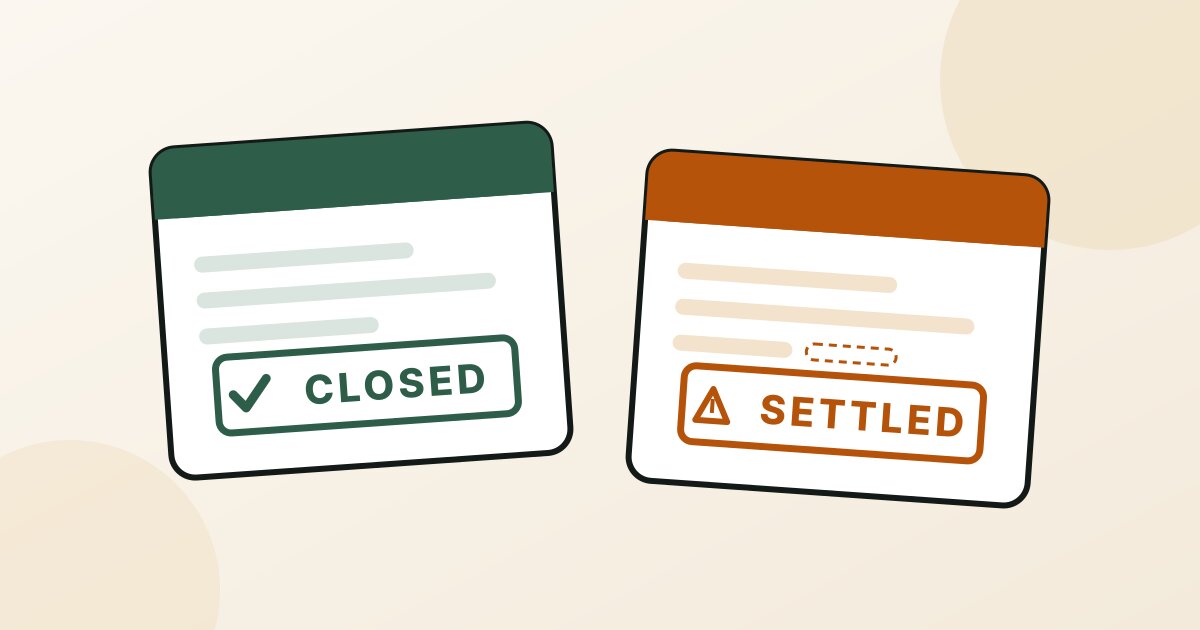
Short answer: a closed loan was repaid in full. A settled loan was ended for less than you owed, and your credit report says so. TransUnion CIBIL says lenders view "settled" as risky. Under RBI's rules, the lender that agreed the settlement cannot lend to you again for at least 12 months, and other lenders may say no or charge more. You can change "settled" to "closed" only by paying the shortfall.
This article is part of our series on getting out of multiple loans. If you are being offered a settlement because EMIs have become too heavy, read it before you sign anything, and look at the ways to reduce your EMIs first.
What does "settled" mean on a CIBIL report?
"Settled" means the lender agreed to take a smaller amount than you owed and close the account. TransUnion CIBIL's own explanation: the bank accepted a payment that "was lesser than the complete amount payable"; had the borrower paid in full, the loan "would have been reported as closed".
Lenders usually offer a settlement only after several missed EMIs, when they doubt they will get the full amount back. So by the time "settled" appears, the report usually already shows the missed payments (days past due) that came before it. The settlement adds a second mark: proof that the lender did not get all its money back.
Settled vs closed vs written off: what each status tells a lender
| Status on the report | What happened | How a new lender reads it |
|---|---|---|
| Closed | You repaid everything due, and the lender issued a No Objection Certificate | You keep your word. The best outcome. |
| Settled | The lender accepted less than the full amount to end the loan | You did not repay in full. Seen as risky. |
| Written off | The lender stopped expecting to recover the money and moved it off its books | Worse than settled: the debt was treated as a loss, and you may still owe it |
A written-off account is still a debt. RBI's June 2023 framework calls this a "technical write-off" when the lender keeps the right to recover, so collection can continue.
Why settling costs you later
The money you do not pay today comes back as a cost in three ways.
1. Your score drops, and the mark stays. Kotak Mahindra Bank's guide on settled status says it typically lowers a CIBIL score by 75 to 100 points, and that it stays on the report for seven years from settlement, with less effect as time passes. Lenders look hardest at recent history; Kotak says settlements within the last 12 to 24 months carry the most weight.
2. The same lender cannot lend to you for at least a year. RBI's Framework for Compromise Settlements and Technical Write-offs (8 June 2023) says that after a compromise settlement, "there shall be a cooling period", and that for loans other than farm credit it "shall be subject to a floor of 12 months". A bank or NBFC can set a longer period in its own policy.
3. Other lenders say no, or charge more. Each lender decides for itself. Many decline applicants with a recent settlement; some approve with a higher rate or a smaller amount. That cost lands exactly when you most need credit: a home loan, a car loan, or an emergency.
A worked example: settle ₹2 lakh, or bring the EMI down?
This is an illustration with round numbers, not a quote.
Priya has a personal loan with ₹2,00,000 outstanding and an EMI she can no longer manage alongside two app loans. After two missed EMIs, the lender offers to settle for ₹1,20,000.
If she settles:
- She pays ₹1,20,000 and the loan ends. The ₹80,000 gap, plus any charges, is the "shortfall".
- The report shows the missed EMIs and then "Settled". By Kotak's estimate that can mean 75 to 100 points off her score, on top of what the missed EMIs already cost.
- That lender cannot lend to her again for at least 12 months.
- To turn "settled" into "closed" later, she has to pay the shortfall the lender confirms. So the ₹80,000 is often deferred, not saved.
If she brings the EMI down before defaulting: suppose a bank lends her ₹2,00,000 to close the old loan at ICICI Bank's published mean rate of 11.60% a year (July to September 2026; actual rates depend on the profile).
| One loan of ₹2 lakh at 11.60% | Monthly EMI | Total interest |
|---|---|---|
| 3 years | ₹6,605 | ₹37,770 |
| 4 years | ₹5,228 | ₹50,924 |
| 5 years | ₹4,409 | ₹64,514 |
A 4-year loan costs about ₹50,900 in interest, plus a processing fee (up to 2% plus taxes at ICICI Bank, about ₹4,720 on ₹2 lakh). That is less than the ₹80,000 shortfall, and the old loan is reported closed, not settled. The longer tenure costs more interest overall, so prepay when you can.
The catch: this route is open only while your record is still reasonably clean. After several missed EMIs, most banks will not refinance, which is why the decision has to be made early. The loan consolidation calculator shows your own numbers.
How to change "settled" to "closed"
- Ask the lender for the exact shortfall in writing: the remaining principal, interest and charges it needs to treat the loan as fully repaid.
- Pay it through a traceable channel (bank transfer, not cash to an agent) and keep the receipt.
- Get a No Objection Certificate (NOC) or a closure letter that says the loan is fully repaid and closed.
- Check your credit report after the next reporting cycle. Since 1 July 2026, RBI requires lenders to report credit information to the bureaus four times a month (as on the 9th, 16th, 23rd and the last day of each month), so the update should not take months.
- If it still says settled, raise a dispute with the bureau (on CIBIL's website for a CIBIL report) and attach the NOC. Under RBI's October 2023 rules, the lender has 21 days and the bureau 9 days, 30 days in all, and you are owed ₹100 a day in compensation for any delay beyond that (for disputes from 26 April 2024).
Before you agree to a settlement
- Try to cut the EMI first. Ask your lender about a longer tenure, or compare a debt consolidation loan or balance transfer that replaces several EMIs with one. Our article on consolidation vs balance transfer vs top-up explains the options.
- Never settle without a written letter stating the amount, the date, and that the lender will report the account (and what status it will report).
- Pay only the lender, through its official account, and be wary of anyone asking for payment elsewhere. RBI requires banks, NBFCs and their recovery agents not to intimidate or harass borrowers, and not to make recovery calls before 8 a.m. or after 7 p.m.
- Do not take a new app loan to fund a settlement. That restarts the cycle. Our payday loan warning explains why.
- Count every loan. If you are juggling app loans and cards too, read how many loans can be merged into one and the warning signs that you need to act now.
How AdvanceCred can help
AdvanceCred is a credit advisory and loan intermediation firm in Mumbai. It is not a lender. If you are still paying on time, or have only just started to miss EMIs, an advisor can compare one-loan options from partner banks and NBFCs so you can close your loans in full instead of settling them. AdvanceCred works on cases with up to 1 payday loan, up to 5 app and personal loans in total and up to 5 credit cards. The bank or NBFC decides approval, amount, rate and tenure.
If you have several app loans, start with payday and app loan consolidation. For bank loans and cards, see merge multiple EMIs into one, or talk to an advisor about your case.
Sources
- TransUnion CIBIL, "Impact of settled status on CIBIL score" (settled vs closed; lenders view settled as risky; dispute to change status), checked 6 November 2026: cibil.com
- Kotak Mahindra Bank, "Settled status and CIBIL score" (typical 75 to 100 point drop; stays seven years; recent 12 to 24 months weigh most; convert by paying the remaining amount), checked 6 November 2026: kotak.bank.in
- Reserve Bank of India, Framework for Compromise Settlements and Technical Write-offs, RBI/2023-24/40, 8 June 2023 (cooling period floor of 12 months for non-farm loans; technical write-offs), checked 6 November 2026: rbi.org.in
- Reserve Bank of India, Frequency of reporting of credit information, RBI/2024-25/60, 8 August 2024 (earlier rule: fortnightly reporting from 1 January 2025), checked 6 November 2026: rbi.org.in
- Reserve Bank of India, Credit Information Companies (Amendment) Directions, 2025, 4 December 2025, in force from 1 July 2026 (credit information as on the 9th, 16th, 23rd and last day of each month; incremental data within four calendar days, full file by the 5th), checked 8 November 2026: rbi.org.in; press release rbi.org.in
- TransUnion CIBIL, Framework for compensation (RBI/2023-24/72 of 26 October 2023: 21 days for the lender, 9 for the bureau, ₹100 a day after 30 days, from 26 April 2024), checked 6 November 2026: cibil.com
- Reserve Bank of India, Responsibilities of regulated entities employing Recovery Agents, RBI/2022-23/108, 12 August 2022, checked 6 November 2026: rbi.org.in
- ICICI Bank, Personal loan interest rates (9.99% to 16.50% p.a.; mean 11.60% for July to September 2026; processing fee up to 2% plus taxes), checked 6 November 2026: icici.bank.in
- EMI figures: standard reducing-balance EMI formula, calculated by AdvanceCred, 6 November 2026.