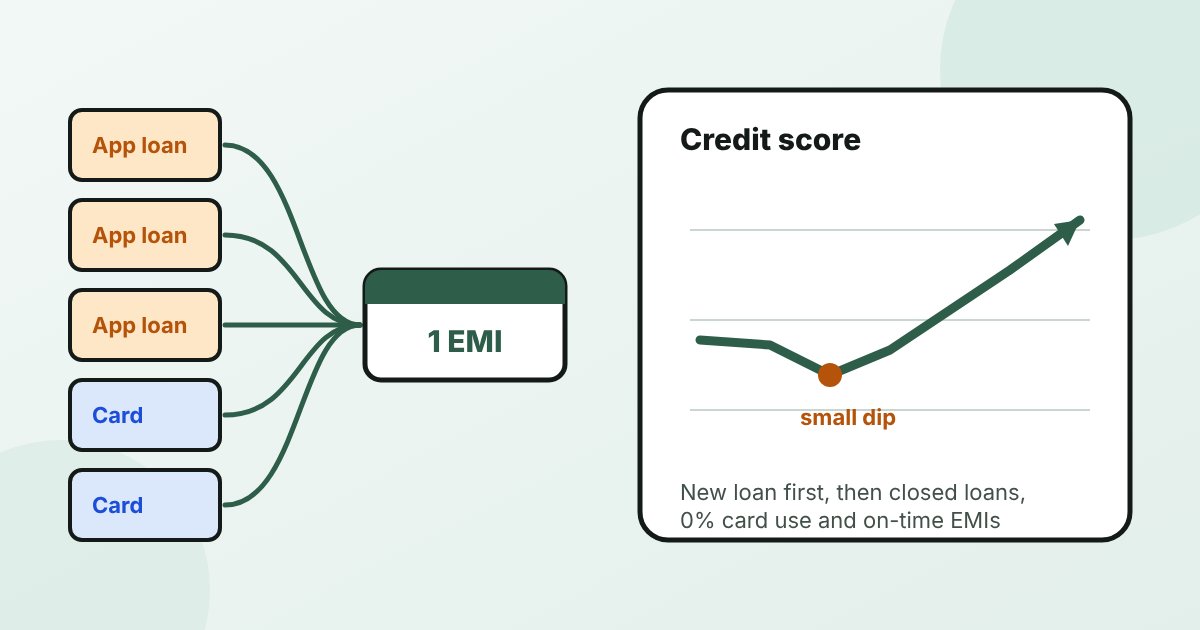
Short answer: debt consolidation usually causes a small, short dip in your CIBIL score and then helps it. The dip comes from the new loan: one hard enquiry and one new account. The help comes after: paid-off card balances lower your credit utilisation, the old loans show as closed, and one EMI is easier to pay on time than five. It hurts if you settle loans instead of closing them, apply to many lenders at once, or run the cards up again.
Your CIBIL score runs from 300 to 900 and is worked out from the accounts and enquiries on your credit report (TransUnion CIBIL). So the useful question is not "does consolidation hurt?" but "what does it change on my report?". The table below goes line by line.
What changes on your CIBIL report when you consolidate?
| What changes | Effect | Why (TransUnion CIBIL's own guidance) |
|---|---|---|
| The new lender checks your report | Small, short-term negative | "Each time you apply for a loan, the lender makes a hard inquiry"; "multiple inquiries in a short period may impact your score" |
| A new loan account opens | Small, short-term negative | A new account has no repayment record yet |
| Old loans show as closed | Neutral to positive | Closed in full is the status lenders want to see (unlike "settled") |
| Credit card balances drop to zero | Positive | "High utilisation can negatively impact your score" |
| One EMI paid on time, every month | The biggest positive | "Making late payments or defaulting on your EMIs has a negative impact on your score" |
| Fewer app loans, one bank or NBFC loan | Can help | CIBIL advises a balanced mix and to "apply for new credit in moderation" |
CIBIL does not publish how many points each item is worth, so be wary of any article that promises a fixed rise or fall.
Does applying for a consolidation loan lower your score?
A little. Every application lets the lender pull your report, and that pull is recorded as a hard enquiry. TransUnion CIBIL's own brochure says multiple enquiries in a short period may impact your score, and its score guide says too many loan enquiries may have a negative impact.
What matters is how many. One or two applications to lenders that fit your profile is normal. Applying to five apps and three banks in the same week tells the next lender you are desperate for credit, and each rejection makes the next approval harder.
Checking your own score is different. TransUnion CIBIL says that when you check your own CIBIL Score, it does not impact it. Check before you apply, so you know what the lender will see.
Does closing old loans and paying off cards help?
Yes, if they are closed in full.
- Loans paid off by the new loan show as closed once each old lender updates its books and reports. Get a closure letter or No Objection Certificate (NOC) from every lender, including each app.
- Cards paid to zero cut your credit utilisation: the share of your card limits you are using. CIBIL does not give a threshold, but it says high utilisation suggests over-reliance on credit and can pull the score down. Our credit card minimum due article shows how fast a carried balance grows.
- Keep the cards open, at zero. CIBIL's own tip is to keep older accounts with a good repayment record open. Closing them removes their limit, so any future spend shows as higher utilisation.
Settled is not closed. If a lender agrees to take less than you owe, the report shows the account as "settled", and later lenders read that as a loss. Our article on settled vs closed on your CIBIL report explains why that costs you for years. Consolidation works for your score because it pays every old loan in full.
Worked example: how one consolidation loan changes a report
This is an illustration with assumed numbers, not a customer's case.
Before. Priya takes home ₹65,000 a month. She has:
- 3 app loans with ₹40,000 outstanding on each: ₹1,20,000
- 2 credit cards, each with a ₹1,00,000 limit, owing ₹70,000 and ₹90,000: ₹1,60,000
- Total owed: ₹2,80,000 across 5 accounts, paid on 5 different dates
Card utilisation = ₹1,60,000 ÷ ₹2,00,000 = 80%.
The new loan. She applies to one bank for a ₹2,80,000 personal loan. At 11.60% a year (ICICI Bank's published mean personal loan rate for July to September 2026), the EMI is:
- 3 years: ₹9,247 a month, ₹52,878 total interest
- 4 years: ₹7,319 a month, ₹71,293 total interest
- 5 years: ₹6,172 a month, ₹90,320 total interest
(EMI = P × r × (1 + r)^n ÷ ((1 + r)^n − 1), with P = ₹2,80,000, r = 11.60% ÷ 12 and n = months.) Her own rate depends on her income, existing obligations and credit history; the lender decides.
After.
| Item on the report | Before | After |
|---|---|---|
| Hard enquiries this month | 0 | 1 |
| Active loan accounts | 3 app loans | 1 bank personal loan |
| App loans | Active | Closed (with NOCs) |
| Card utilisation | 80% | 0%, both cards kept open |
| Payment dates a month | 5 | 1 |
The one enquiry and the new account may cause a small dip for a few weeks. The closed loans and the 0% utilisation show as each lender reports, and every on-time EMI after that adds to her record. CIBIL keeps up to 36 months of monthly payment history, so the next year of payments matters more than the first week.
When does debt consolidation hurt your CIBIL score?
- You apply everywhere at once. Several hard enquiries in a short period may impact your score, and rejections lead to more applications. Shortlist first.
- You settle instead of closing. A "settled" status stays on the report and later lenders treat it as a loss.
- You run the cards up again. Then you have the new loan and the card debt, and utilisation is back where it started.
- The new EMI is too high for your salary. A missed EMI on the new loan does the damage consolidation was meant to stop. Choose the tenure where the EMI fits, then prepay when you can.
- An old loan is never marked closed. If a lender or app does not update its records, the report shows a loan you no longer have. Keep every NOC and check your report after the next reporting cycle.
- You keep borrowing from apps. A new app loan in the months after consolidating undoes most of the gain.
How long until the score reflects it?
Since 1 July 2026, RBI requires lenders to report to the credit bureaus as on the 9th, 16th, 23rd and last day of every month. So a loan closed in the lender's books, or a card paid to zero, can reach your report within about one to two weeks. Our article on how often your CIBIL report is updated has the dates and what to do if a closed loan still shows as active.
Before you apply: a short checklist
- Check your own report (free and does not affect your score). Note every loan, card and overdue amount.
- List what you owe: outstanding, EMI or card due, and rate for each. The Can I merge my loans? checker does the arithmetic and shows one EMI over 3 and 5 years.
- Check the foreclosure charges in each loan's Key Facts Statement or sanction letter. RBI's Pre-payment Charges Directions, 2025 bar these charges on floating-rate loans to individuals for non-business purposes sanctioned or renewed from 1 January 2026; most app and personal loans are fixed-rate, so their own terms decide.
- Apply to one or two lenders that fit, not ten.
- Close every old loan in full and collect each NOC.
- Keep cards open at zero and set up auto-pay for the new EMI.
If your score is already low, read debt consolidation with a low CIBIL score first: it explains what lenders check and what to fix before you apply.
How AdvanceCred can help
AdvanceCred is a Mumbai-based credit advisory and loan intermediation firm, not a lender. An advisor reviews your loans, income and credit report first, then approaches the partner banks and NBFCs most likely to fit your profile, so you do not have to apply everywhere yourself. AdvanceCred works on cases with up to 1 payday loan, up to 5 app and personal loans and up to 5 credit cards. The lender decides approval, amount, rate and tenure.
See how it works on merging multiple EMIs into one or the debt consolidation loan page, or ask for a call back.
Sources
- TransUnion CIBIL, All you need to know about your CIBIL score and how it is calculated (score from 300 to 900; late payments, high utilisation and too many loan enquiries may have a negative impact; balanced mix of secured and unsecured loans; "apply for new credit in moderation"), checked 13 November 2026.
- TransUnion CIBIL, Understanding your CIBIL score and report (checking your own score does not impact it; hard inquiry on each loan application; multiple inquiries in a short period may impact your score; high utilisation; keep older accounts open; monthly payment history up to 36 months; account status open, closed, settled or written-off), checked 13 November 2026.
- TransUnion CIBIL, FAQs: understand your credit score and report (score based on the Accounts and Enquiries sections of the report), checked 13 November 2026.
- Reserve Bank of India, Credit Information Companies (Amendment) Directions, 2025, in force from 1 July 2026 (credit information as on the 9th, 16th, 23rd and last day of the month), rbi.org.in, checked 6 November 2026.
- Reserve Bank of India, Pre-payment Charges on Loans Directions, 2025, checked 26 October 2026.
- ICICI Bank, Personal loan interest rates (mean rate 11.60% for July to September 2026), checked 7 November 2026.
This article is general information, not financial advice or an offer of credit.