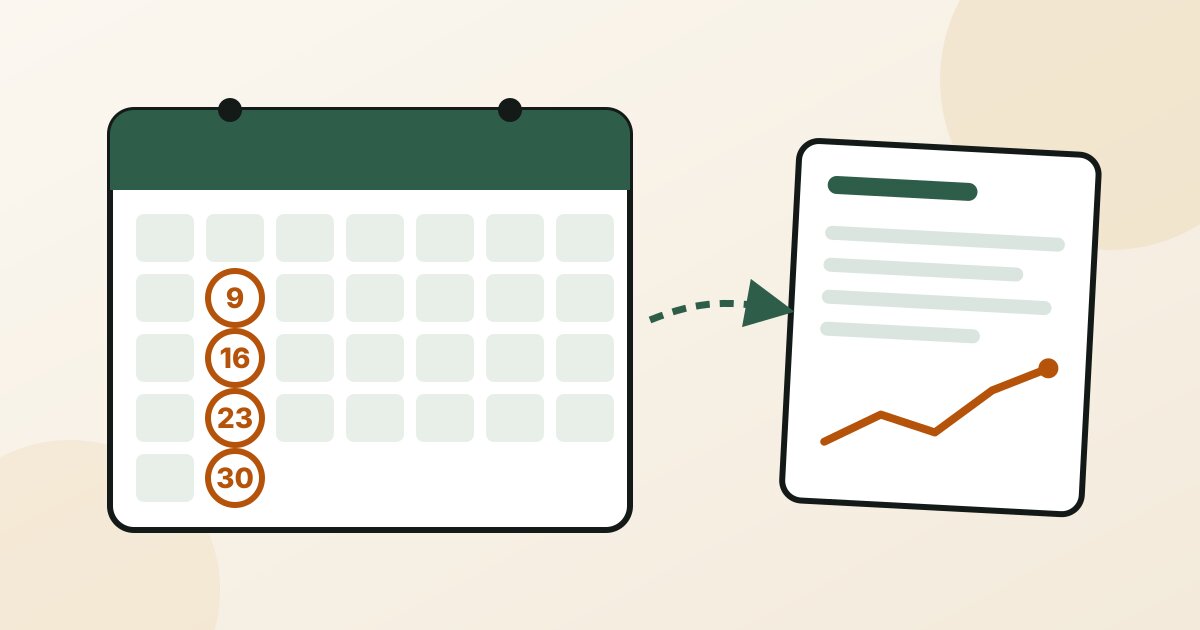
Short answer: since 1 July 2026, RBI requires every bank and NBFC to report your loans and credit cards to the credit bureaus four times a month, as on the 9th, 16th, 23rd and the last day of the month. Data for the first three dates must reach the bureau within four calendar days, and the month-end file by the 5th of the next month. So a closed loan or a missed EMI can appear on your CIBIL report within about one to two weeks.
This article is part of our series on getting out of multiple loans. If you are about to close a loan, or worried about a missed EMI, the dates below tell you when your report will change.
How often is the CIBIL report updated now?
Your CIBIL report changes when a lender sends new data. RBI's Credit Information Companies (Amendment) Directions, 2025, dated 4 December 2025 and in force from 1 July 2026, require lenders to submit credit information "as on 9th, 16th, 23rd and last day of the month". RBI's press release called this a transition to weekly incremental submission.
| Reference date | Lender must submit by | What is sent |
|---|---|---|
| 9th | 13th | Changes since the last date (incremental) |
| 16th | 20th | Changes since the last date (incremental) |
| 23rd | 27th | Changes since the last date (incremental) |
| Last day of the month | 5th of the next month | Full file of all your accounts |
The bureau then has three calendar days from receipt to load the file and send the lender a report of any records it rejected. A rejected record is corrected and sent again with the next submission.
How it was before: from 1 January 2025, RBI's earlier rule required reporting every fortnight. Many articles and lender pages still say "fortnightly"; that rule has been replaced.
Does "four times a month" mean my score changes every week?
Not necessarily. Your score is worked out from the data in your report, so it can move only when new data arrives, and only if that data changes something: a balance going down, a loan closing, a card bill paid in full, or a payment going overdue. If nothing about your accounts changed, a new reporting date changes nothing.
Each lender reports on its own schedule within the RBI deadlines. So your home loan, two cards and an app loan may update on different days, and one lender's data can be newer than another's.
How long after closing a loan does CIBIL update?
Count from the day the lender marks the loan closed in its own books, not the day you paid. Then the loan goes out on the next reference date.
Worked example (November 2026):
| You close the loan on | Next reference date | Lender submits by | Bureau loads it by about |
|---|---|---|---|
| 3 November | 9 November | 13 November | 16 November |
| 10 November | 16 November | 20 November | 23 November |
| 24 November | 30 November | 5 December | 8 December |
The last row is the slowest case: a closure just after the 23rd waits for the month-end full file. The "loaded by" column assumes the lender submits on its deadline and the bureau uses its full three days; many will be quicker.
TransUnion CIBIL's own FAQ (checked 11 November 2026) still says lenders "generally submit data to CIBIL within a span of 30-45 days" and that a report bought within 45 days of closure "may not be updated". That text describes the older cycle. Under the 2026 rule, if nothing shows after about three weeks, it is worth checking with the lender before you wait longer.
How fast does a missed EMI show?
Fast. Say your EMI is due on the 5th and you miss it.
- On the 9th, the account is 4 days past due. If it is still unpaid, the lender's next submission (due by the 13th) can carry the overdue amount and the days past due.
- If you pay on the 7th, the account is up to date by the 9th, but the lender may still record that the payment came late. How a short delay is recorded depends on the lender's reporting.
- If the EMI stays unpaid, each reporting date shows a higher days-past-due count: about 11 days on the 16th, 18 on the 23rd and 25 on the 30th.
Under the 2025 fortnightly cycle, a missed EMI could take up to two weeks or more to show. Now it can show within a week. RBI's October 2023 rules also require lenders to alert you by SMS or email when they report a default to the bureaus, so do not ignore those messages.
What this means if you have several loans: a missed EMI on one app loan can lower your score before your next salary arrives. That is the moment many people take another app loan to cover it. Our article on the warning signs of taking a loan to pay another loan explains when to act, and the loan consolidation calculator shows whether one loan could replace them.
Settled, closed or still active: what the report will say
When the update comes through, check what status the lender reported:
- Closed: you repaid in full. The best outcome.
- Settled: the lender accepted less than you owed. Lenders treat this as a warning sign for years. Our guide to settled vs closed on your CIBIL report explains how to change it.
- Still active with a balance: either the lender has not reported the closure yet, or something went wrong. Follow the steps below.
What to do if your report has not updated
- Get the closure in writing. Ask the lender for a No Objection Certificate (NOC) or a closure letter that says the loan is fully repaid.
- Wait for one full cycle. Use the table above: if the loan was closed on the 10th, check after about the 23rd.
- Check your report. RBI requires each credit bureau to give you one free full credit report a year, with the link on the bureau's home page.
- Raise a dispute on the bureau's website (CIBIL's, for a CIBIL report) and attach the NOC. The bureau cannot change your data itself; it asks the lender to confirm.
- Know the deadline. Under RBI's October 2023 compensation framework, the lender has 21 days and the bureau 9 days, 30 days in all, to resolve your complaint. After 30 days, you are owed ₹100 for every day of delay.
What the faster cycle means for borrowers with several EMIs
The 2026 rule works both ways.
- Good news: when you close loans, the improvement shows faster. If you replace three app loans and two cards with one bank loan, the old accounts can show as closed within a couple of weeks of the lender closing them.
- Bad news: a missed EMI now reaches your report within days. If your EMIs already take half or more of your take-home pay, the room to recover from one bad month is smaller.
So the best time to act is while every EMI is still being paid on time. That is when banks are most willing to refinance, and when merging multiple EMIs into one is a real option. If your score has already dropped, see debt consolidation with a low CIBIL score for what lenders will and will not consider. If you have payday or app loans, start with payday and app loan consolidation.
How AdvanceCred can help
AdvanceCred is a credit advisory and loan intermediation firm in Mumbai. It is not a lender. If you are still paying on time, or have only just started to miss EMIs, an advisor can compare one-loan options from partner banks and NBFCs so you can close your loans in full and let the next reporting dates show them as closed. AdvanceCred works on cases with up to 1 payday loan, up to 5 app and personal loans in total and up to 5 credit cards. The bank or NBFC decides approval, amount, rate and tenure.
Tell us about your loans on the debt consolidation page, or talk to an advisor about your case.
Sources
- Reserve Bank of India, Credit Information Companies (Amendment) Directions, 2025, RBI/DOR/2025-26/119, 4 December 2025, in force from 1 July 2026 (credit information as on the 9th, 16th, 23rd and last day of the month; incremental data within four calendar days; full file by the 5th of the next month; bureaus to ingest files and share rejection reports within three calendar days of receipt; rejected records resubmitted with the next submission), checked 11 November 2026: rbi.org.in; press release, 4 December 2025 ("transition to weekly incremental submission"), checked 8 November 2026: rbi.org.in
- Reserve Bank of India, Frequency of reporting of credit information, RBI/2024-25/60, 8 August 2024 (earlier rule: fortnightly reporting from 1 January 2025), checked 6 November 2026: rbi.org.in
- Reserve Bank of India, Framework for compensation to customers for delayed updation / rectification of credit information, RBI/2023-24/72, 26 October 2023 (21 days for the lender, 9 for the bureau, 30 days in all; ₹100 a calendar day after that; in force six months from the circular), checked 11 November 2026: rbi.org.in
- Reserve Bank of India, Strengthening of customer service rendered by Credit Information Companies and Credit Institutions, RBI/2023-24/73, 26 October 2023 (lenders to alert customers by SMS or email when submitting default information; one free full credit report a year from each bureau), checked 11 November 2026: rbi.org.in
- TransUnion CIBIL, FAQs on loan rejections and disputes ("generally submit data to CIBIL within a span of 30-45 days"; report bought within 45 days of closure "may not be updated"; CIBIL "cannot make any change directly" without the lender's confirmation; disputes take about 30 days), checked 11 November 2026: cibil.com
- Dates in the worked examples: calculated by AdvanceCred from the RBI deadlines above, 11 November 2026.