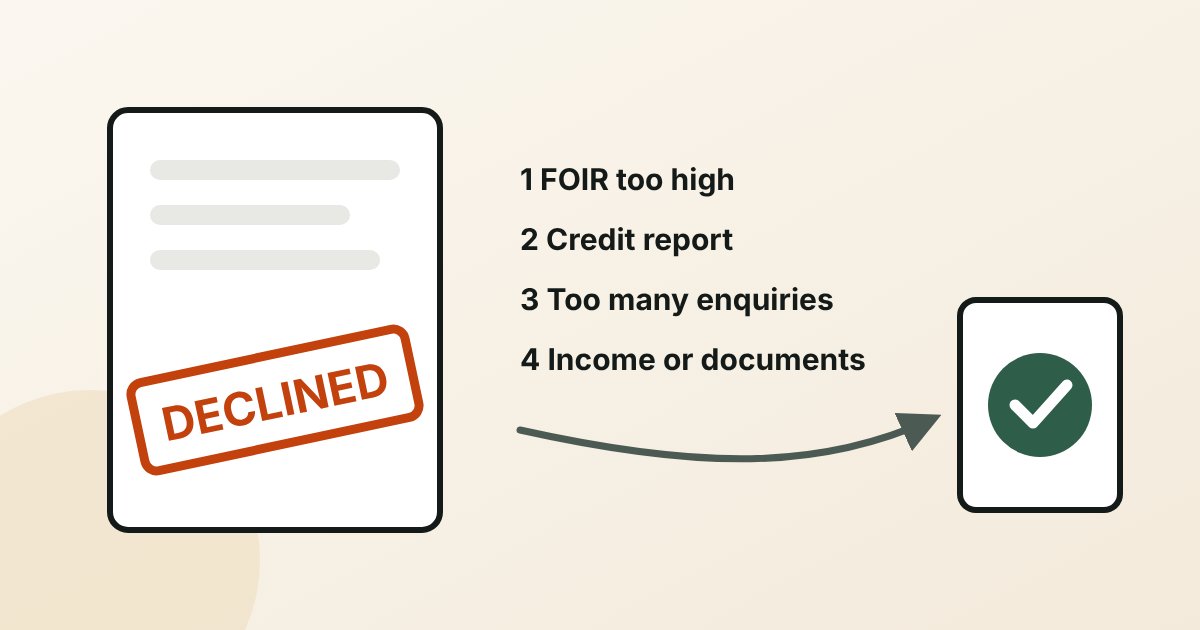
Short answer: most personal loan rejections come down to four things: EMIs already taking too much of your salary (FOIR), a weak or wrong credit report, too many recent loan applications, or income and documents that do not meet the lender's policy. Do not reapply at another lender the same week. Find the reason, check your credit report, fix what you can, then apply to one or two lenders that suit your profile.
A rejection feels personal, but it is a lender's policy check, and each lender's policy is different. A profile one bank declines can fit another. This guide shows how to find your reason, a worked example of the most common one, and what to do in the next 30 days.
Why do personal loans get rejected?
| Reason | How to tell | What fixes it |
|---|---|---|
| High FOIR: existing EMIs plus the new EMI take too much of your income | Your EMIs and card minimum dues are already above about 40% of take-home pay | Smaller amount, longer tenure, close small loans first, or consolidate |
| Credit score or repayment record | Missed EMIs, "settled" or "written off" accounts, high card use | Time and on-time payments; settle nothing if you can close it |
| Errors in your credit report | A loan that is not yours, a closed loan shown as active, wrong personal details | Dispute with the bureau (about 30 days, CIBIL says) |
| Too many recent applications | Several enquiries in the last few months | Stop applying; wait a few months |
| Income, employer or documents | Salary below the lender's minimum, employer not on its list, mismatched documents | A lender whose policy fits, or complete documents |
Kotak 811 lists the same pattern: a low score or faults in credit history, errors in the report, maxed-out credit cards, multiple recent enquiries, applying for several loans at once, a high FOIR (it suggests below 40%) and not showing all income.
Who actually decided to reject you?
The lender, not the credit bureau. TransUnion CIBIL says the decision to grant a loan depends solely on the credit policy of the lender. CIBIL only holds the data lenders report, and it cannot change your report on its own. So the first step is always to ask the lender which reason applied to you, in writing if you can. Kotak 811 advises reading the lender's rejection notice for the specific reasons; knowing the real reason saves weeks of guessing.
A worked example: rejected because of FOIR
Rahul (an illustration, not a real customer) takes home ₹35,000 a month. He already pays ₹16,000 a month in EMIs: a two-wheeler loan, two app loans and a card EMI. He applies for a fresh ₹2 lakh personal loan over 3 years.
- FOIR before the new loan: ₹16,000 ÷ ₹35,000 = 45.7%.
- New EMI: ₹2 lakh over 3 years at 11.60% (ICICI Bank's published mean rate for July to September 2026) = ₹6,605.
- FOIR with the new loan: (₹16,000 + ₹6,605) ÷ ₹35,000 = 64.6%.
Kotak Mahindra Bank says lenders prefer a FOIR of 40% to 50%, and IndusInd Bank says banks generally do not approve loans above 50%. At 64.6%, the rejection is no surprise. Even over 5 years (EMI ₹4,409), FOIR would be 58.3%.
What would fit? At a 50% limit, Rahul's maximum total EMIs are ₹17,500. He has room for only ₹1,500 more, which repays about ₹68,000 over 5 years. A second loan on top is the wrong tool. The better question is whether one consolidation loan can replace the two app loans and the card EMI with a single, longer, cheaper EMI, so his monthly outgo falls instead of rising. See FOIR explained for the full calculation, or enter your own numbers in the eligibility calculator.
What to do in the next 30 days
- Do not apply anywhere else this week. Each application adds an enquiry. TransUnion CIBIL says one enquiry has minimal impact, but many in a short time make you look credit-hungry, so a burst of applications after a rejection can cause the next one.
- Ask the lender for the reason. Note the date, the amount and the lender's answer.
- Get your credit report and check every account and enquiry. Under RBI's rules you are entitled to one free full credit report a year from each credit bureau.
- Dispute any errors. Use the bureau's online dispute form. CIBIL says a dispute takes about 30 days, depending on the lender's reply. Under RBI's compensation framework, the lender has 21 days and the bureau 9 days; after 30 days in all you are entitled to ₹100 for each day of delay.
- Work out your FOIR honestly, including card minimum dues and app loan EMIs. If it is above 40% to 50%, a smaller amount, a longer tenure or consolidation will work better than a fresh application.
- Stop new borrowing, especially app loans and buy-now-pay-later plans, until you reapply.
- Reapply to one or two lenders whose policy fits: your salary above their minimum, your employer category accepted, your documents complete.
When the problem is too many loans
If your rejection came from several running loans, more borrowing makes it worse. Three routes usually fit better:
- One consolidation loan that closes app loans and card dues over a longer tenure. See how to merge multiple EMIs into one.
- A top-up or a second loan only if FOIR allows. Personal loan with existing loans shows when each one works.
- Own a house or flat? A home loan top-up or a loan against property can carry a lower rate and a longer tenure. Your property is mortgaged and can be at risk if EMIs are missed.
AdvanceCred works on consolidation cases with up to 1 payday loan, up to 5 app loans and personal loans in total, and up to 5 credit cards. If your report already shows missed payments, read does debt consolidation hurt your CIBIL score? and our page on debt consolidation with a low CIBIL score.
Mistakes that turn one rejection into five
- Applying to every app that says "instant approval". Each one adds an enquiry, and app loans add short, large EMIs that raise FOIR further.
- Hiding a loan. Lenders see every reported loan on your credit report. Since 1 July 2026 lenders report to the bureaus four times a month, so a new loan shows up quickly.
- Settling a loan to "clean" the report. A settled account is reported as settled, which lenders read as a loss. See settled vs closed on your CIBIL report.
- Paying someone to "fix" your score. Only the lender that reported the data can correct it, through the bureau's dispute process.
How AdvanceCred can help
AdvanceCred is a credit advisory and loan intermediation firm in Mumbai, not a lender. An advisor will look at why you were declined, work out your FOIR with your real EMIs, and tell you plainly which of our partner banks and NBFCs are likely to fit, or whether you should consolidate or wait first. The lender decides approval, amount, rate and tenure. Check your loans with the free loan-merge checker, see all our debt consolidation guides, compare personal loan options, or share your details in the form below.
Sources
Checked on 19 November 2026 unless stated. The salary example is an illustration; EMI and FOIR figures are AdvanceCred's own arithmetic (standard reducing-balance EMI formula).
- TransUnion CIBIL, FAQ: Loan rejections and disputes (the decision to grant a loan depends solely on the lender's credit policy; disputes take about 30 days subject to the lender's response; CIBIL cannot change the report directly): cibil.com
- Kotak 811, Your personal loan got rejected? Here's what to do next, updated 15 January 2025 (reasons including credit history, report errors, maxed-out cards, multiple enquiries, FOIR below 40%, undeclared income): kotak811.bank.in
- Kotak Mahindra Bank, What is FOIR in banking?, 8 September 2026 (lenders prefer 40% to 50%): kotak.bank.in
- IndusInd Bank, What is the meaning of FOIR in banking and how it is calculated, updated 14 October 2026 (banks generally do not approve loans above 50%): indusind.bank.in
- ICICI Bank, Personal loan interest rates (10.25% to 16.50% a year; mean 11.60% for July to September 2026): icici.bank.in
- TransUnion CIBIL, Why did I get an enquiry on my credit report? (one enquiry has minimal impact; many in a short time can look credit-hungry), checked 19 October 2026: cibil.com
- Reserve Bank of India, Framework for compensation to customers for delayed updation / rectification of credit information, RBI/2023-24/72, 26 October 2023 (21 days for the lender, 9 for the bureau; ₹100 a calendar day after 30 days), checked 11 November 2026: rbi.org.in
- Reserve Bank of India, Strengthening of customer service rendered by Credit Information Companies and Credit Institutions, RBI/2023-24/73, 26 October 2023 (one free full credit report a year from each bureau; alerts when your report is accessed): rbi.org.in
- Reserve Bank of India, Credit Information Companies (Amendment) Directions, 2025, 4 December 2025, in force from 1 July 2026 (reporting as on the 9th, 16th, 23rd and last day of each month), checked 8 November 2026: rbi.org.in
This article is general information, not financial advice or an offer of credit. Lenders' policies differ; the lender decides approval, amount, rate and tenure.