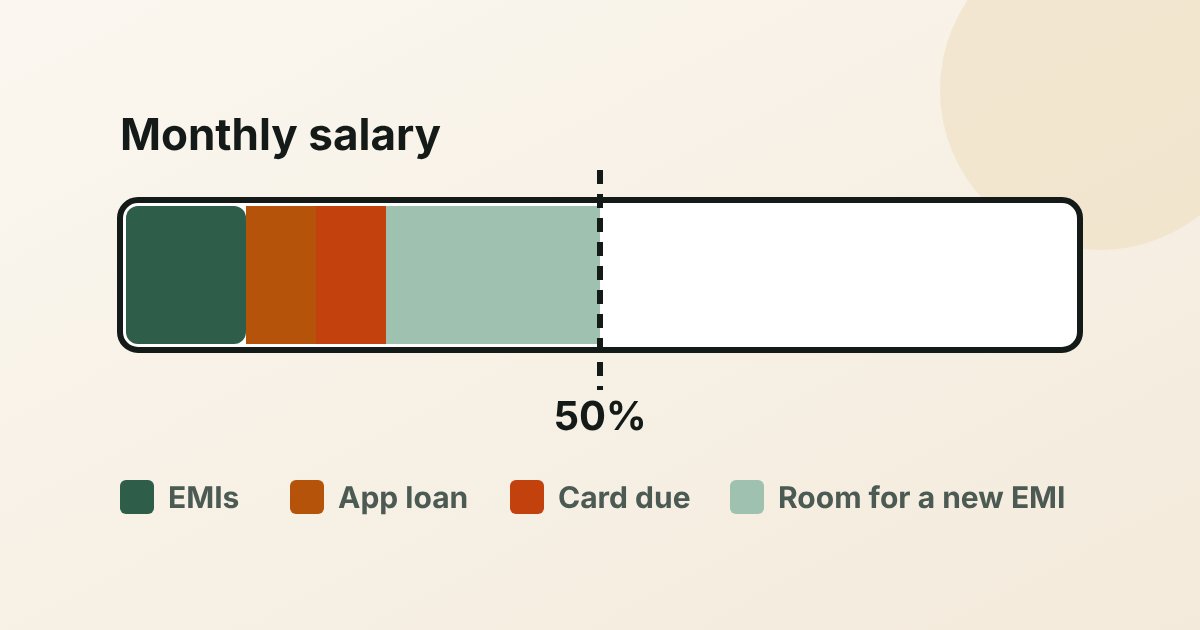
Short answer: FOIR (fixed obligation to income ratio) is the share of your monthly income already going to EMIs and other fixed payments. Most banks want it at about 40% to 50%, after the new loan's EMI is added. Kotak Mahindra Bank says lenders prefer 40% to 50%, and IndusInd Bank says banks generally do not approve loans above 50% (both checked 19 November 2026).
FOIR is the single number that most often decides how much you can borrow on a salary. A good credit score will not get a loan approved if your EMIs already take most of your pay. This guide shows how lenders calculate it, what counts, a worked example on a ₹45,000 salary, and the fastest ways to bring it down.
What is FOIR?
FOIR is the share of your monthly income that is already committed to fixed payments. Lenders use it to check whether you can afford one more EMI without missing the ones you already pay. The lower your FOIR, the more room you have for a new loan, and the better your chances of approval at a good rate.
You will also see it called the debt-to-income ratio. In Indian lending, FOIR is the usual term on bank and NBFC pages.
How is FOIR calculated?
FOIR = total fixed monthly obligations ÷ monthly income × 100.
Kotak Mahindra Bank gives exactly this formula. IndusInd Bank says it uses gross monthly income, which is pay before tax and provident fund deductions. Many lenders work from take-home pay instead, so the same borrower can show a different FOIR at two banks. When you work it out yourself, use your take-home pay: it gives the stricter answer.
Lenders also check FOIR after adding the EMI of the loan you are applying for. A FOIR of 30% today can become 48% once the new EMI is counted.
What counts as a fixed obligation?
| Payment | Counted? | What lenders say |
|---|---|---|
| EMIs on personal, home, car and two-wheeler loans | Yes | Every lender counts existing EMIs (Kotak, IndusInd) |
| EMIs on app loans and buy-now-pay-later plans | Yes | They are loans and appear on your credit report |
| Minimum due on credit cards | Yes | IndusInd Bank lists minimum card dues |
| Rent | Some lenders | IndusInd Bank lists rent; others ignore it |
| Insurance premiums, utility bills | Some lenders | IndusInd Bank lists them |
| Groceries, school fees, travel | No | Not fixed obligations in FOIR |
Two points catch people out. First, app loans count in full even when they are small: RBI's Digital Lending Directions, 2025 require regulated lenders to report every loan made through an app to the credit bureaus, so the next bank sees them. Second, a card balance counts even if you have no EMI, because the minimum due is treated as a monthly obligation.
A worked example: ₹45,000 take-home salary
Priya (an illustration, not a real customer) takes home ₹45,000 a month. She pays:
- Two-wheeler loan EMI: ₹3,200
- App loan EMI: ₹4,800
- Credit card minimum due on her statement: ₹4,000
Her FOIR today: ₹3,200 + ₹4,800 + ₹4,000 = ₹12,000. ₹12,000 ÷ ₹45,000 = 26.7%.
Now she applies for a personal loan. What the lender can offer depends on its FOIR limit:
| Lender's FOIR limit | Maximum total EMIs (₹45,000 × limit) | Room for a new EMI | Loan that EMI repays over 5 years at 11.60% |
|---|---|---|---|
| 40% | ₹18,000 | ₹6,000 | about ₹2.72 lakh |
| 50% | ₹22,500 | ₹10,500 | about ₹4.76 lakh |
The rate is ICICI Bank's published mean personal loan rate of 11.60% for July to September 2026 (its range is 10.25% to 16.50%, checked 19 November 2026). Your own rate depends on your credit report, employer and income. The loan amounts use the standard reducing-balance EMI formula: at 11.60%, every ₹1 lakh borrowed over 5 years costs about ₹2,204 a month.
What the app loan and the card cost her in borrowing power: together they take ₹8,800 of her monthly room. If both were closed, the room at a 50% limit would be ₹19,300, which supports about ₹8.76 lakh over 5 years instead of ₹4.76 lakh. Small, expensive loans reduce how much cheaper credit you can get.
Gross vs take-home: if Priya's gross pay is ₹52,000, a lender using gross income sees a FOIR of ₹12,000 ÷ ₹52,000 = 23.1%, not 26.7%. Same person, different answer. That is one reason two banks can make different offers.
Try your own numbers in the personal loan eligibility calculator, which does this arithmetic for a 40%, 50% or 60% limit.
What FOIR do banks accept?
Usually 40% to 50% including the new EMI, sometimes more for higher salaries. Kotak Mahindra Bank says lenders prefer a FOIR of 40% to 50% and that a higher FOIR can make approval harder or lead to a higher rate. IndusInd Bank says banks generally do not approve loans when FOIR exceeds 50%. Kotak 811 suggests keeping it below 40%.
There is no RBI rule fixing one FOIR limit for personal loans. Each bank and NBFC sets its own in its credit policy, so a profile that one lender declines can fit another. That is also why applying to many lenders at once does not help: every application adds an enquiry to your credit report, and TransUnion CIBIL says many enquiries in a short time can make you look credit-hungry.
How to lower your FOIR before you apply
- Close the smallest, costliest loans first. An app loan with a short tenure has a large EMI for the amount owed. Clearing it frees more monthly room than paying the same rupees into a long bank loan.
- Bring card balances down. A lower outstanding means a lower minimum due, and IndusInd Bank counts the minimum due as an obligation.
- Stop new borrowing for a few months. No new app loans, buy-now-pay-later plans or card EMIs before you apply. Kotak advises delaying new borrowing if you plan to take a personal loan soon.
- Declare every regular income source. Rental income or a regular allowance can count if you can document it. IndusInd Bank lists documenting all income among the ways to improve FOIR.
- Add a co-applicant where the lender allows it. A working spouse's income can be added to the calculation for some loans.
- Choose a longer tenure for the new loan. A longer tenure means a smaller EMI and a lower FOIR, though you pay more interest in total. Prepay later when you can.
- Consider one consolidation loan. If three or four EMIs are pushing FOIR above 50%, one loan that closes them over a longer tenure can lower the total monthly outgo. See how to merge multiple EMIs into one.
FOIR above 50% already? What to do
If your EMIs already take more than half of your take-home pay, a new loan on top is unlikely and would make things harder. That is also one of the six signs in taking a loan to pay another loan: signs to act. Two routes usually work better:
- Replace, do not add. A personal loan with existing loans shows when a top-up or one consolidation loan beats a second loan.
- Own a house or flat? A home loan top-up or a loan against property can carry a lower rate and longer tenure. Your property is mortgaged and can be at risk if EMIs are missed, so take it only with a clear plan.
AdvanceCred works on consolidation cases with up to 1 payday loan, up to 5 app loans and personal loans in total, and up to 5 credit cards. See how many loans can be merged into one for why the count matters.
How AdvanceCred can help
AdvanceCred is a credit advisory and loan intermediation firm in Mumbai, not a lender. An advisor will work out your FOIR with your actual EMIs and card dues, tell you which of our partner banks and NBFCs are likely to accept it, and whether a fresh loan, a top-up or one consolidation loan fits. The lender decides approval, amount, rate and tenure. Start with the free loan-merge checker, browse all our debt consolidation guides, or share your details in the form below.
Sources
Checked on 19 November 2026 unless stated. The salary example is an illustration; EMI and loan figures are AdvanceCred's own arithmetic (standard reducing-balance EMI formula).
- Kotak Mahindra Bank, What is FOIR in banking? Decoding FOIR and its impact on personal loan approval, 8 September 2026 (FOIR = total monthly fixed obligations ÷ monthly income × 100; lenders prefer 40% to 50%; reduce debt and delay new borrowing): kotak.bank.in
- IndusInd Bank, What is the meaning of FOIR in banking and how it is calculated, updated 14 October 2026 (gross monthly income; rent, loan EMIs, insurance premiums, minimum credit card dues and utility bills counted; banks generally do not approve loans above 50%; ways to improve): indusind.bank.in
- Kotak 811, Your personal loan got rejected? Here's what to do next, updated 15 January 2025 (keep FOIR below 40%): kotak811.bank.in
- ICICI Bank, Personal loan interest rates (10.25% to 16.50% a year; mean 11.60% for July to September 2026): icici.bank.in
- Reserve Bank of India, Reserve Bank of India (Digital Lending) Directions, 2025, 8 May 2025 (para 16(i): loans through digital lending apps reported to credit information companies), checked 18 November 2026: rbi.org.in
- TransUnion CIBIL, Why did I get an enquiry on my credit report? (many enquiries in a short time can look credit-hungry), checked 19 October 2026: cibil.com
This article is general information, not financial advice or an offer of credit. Lenders' rates and rules change; check the lender's current Key Facts Statement before you borrow.