Short answer: there are four ways to bring down the EMI on a personal loan you already have: ask your lender to extend the tenure, part-pay the principal, move the loan to a cheaper lender, or merge several costly loans into one. A longer tenure gives the biggest drop but adds interest. A balance transfer only saves money when the rate gap is wide enough to cover the old lender's foreclosure charge and the new lender's fee. Work out the total cost of each before you choose.
If your EMIs take more of your salary than they did when you borrowed, because of a new loan, a pay cut or a family cost, the instinct is to borrow more to cover the gap. That usually makes it worse. Start with the options below, in this order.
Option 1: ask your lender to extend the tenure
This is the quickest way to a lower EMI, and it does not need a new loan. You write to your lender (branch, app or customer care) and ask to spread the outstanding amount over more months. ICICI Bank's personal loan FAQ, for example, says the EMI "can be adjusted by changing the loan tenure or opting for a Balance Transfer". The lender decides, based on your repayment record, income and its own policy.
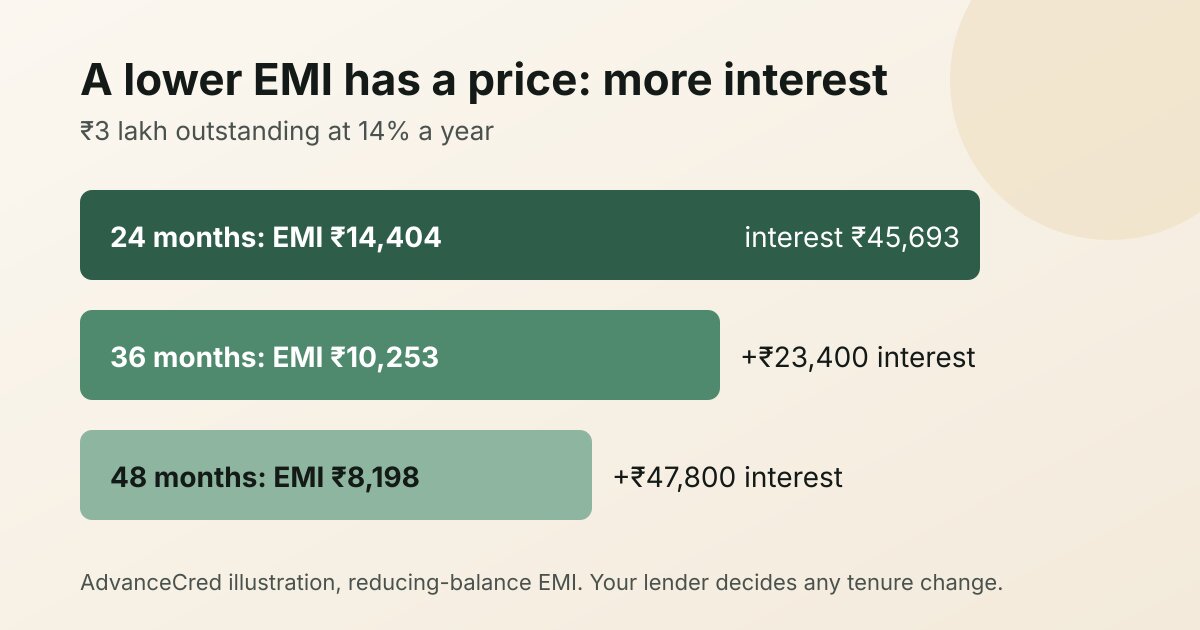
The cost is more interest, because you borrow the money for longer. Here is a loan with ₹3 lakh outstanding at 14% a year and 24 months left:
| Remaining tenure | EMI | Total interest from now | Extra interest | EMI drop |
|---|---|---|---|---|
| 24 months (as now) | ₹14,404 | ₹45,693 | nil | nil |
| 36 months | ₹10,253 | ₹69,118 | about ₹23,400 | ₹4,151 |
| 48 months | ₹8,198 | ₹93,501 | about ₹47,800 | ₹6,206 |
Stretching to 36 months frees ₹4,151 a month for about ₹23,400 of extra interest over the life of the loan. That trade can be worth it if the alternative is a missed EMI or an app loan. Ask about any charge for the change, and get the new schedule in writing. The fee pages of HDFC Bank, ICICI Bank, Kotak, SBI and Bajaj Finance we checked on 23 November 2026 list no separate personal loan rescheduling fee, but the terms in your own loan agreement apply.
If your loan is floating-rate
Most personal loans are fixed-rate. If yours is floating-rate, RBI's rules give you specific rights when the rate is reset:
- the lender must offer you a higher EMI, a longer tenure, or a mix of both, and let you prepay in part or in full;
- extending the tenure must not lead to negative amortisation (the balance growing because the EMI no longer covers the interest);
- you must get a quarterly statement showing principal and interest paid to date, the EMI, the number of EMIs left and the APR;
- the lender may offer a switch to a fixed rate under its own policy, with the charges disclosed in your sanction letter.
Option 2: part-pay the principal and keep the tenure
If you have a lump sum, such as a bonus or a maturing deposit, part-paying the principal and asking the lender to keep the tenure and lower the EMI gives a permanent drop with no extra interest. On a ₹3 lakh loan at 11.60% after 12 EMIs, a ₹50,000 part-payment brings the EMI from ₹9,907 to about ₹7,563 over the remaining 24 months.
Lenders limit how often and how much you can part-pay, and many charge 2% to 4% on the amount. Our guide to personal loan foreclosure and part-payment charges has each lender's rules and the worked example. On floating-rate loans to individuals sanctioned from 1 January 2026, RBI does not allow pre-payment charges. Clear credit card dues and app loans before part-paying a bank loan: they cost far more.
Option 3: move the loan to a cheaper lender (balance transfer)
A new lender pays off your old loan and you repay it at a lower rate. It only saves money if the rate gap beats the costs: the old lender's foreclosure charge (often 3% to 4% of the outstanding, plus GST) and the new lender's processing fee.
The same ₹3 lakh, 24 months left, with a 4% foreclosure charge and a 2% processing fee, both plus 18% GST:
| Stay at 14% | Move to 11.5%, 24 months | Move to 11.5%, 36 months | |
|---|---|---|---|
| EMI | ₹14,404 | ₹14,052 | ₹9,893 |
| Interest from now | ₹45,693 | ₹37,250 | ₹56,141 |
| Charges to switch | nil | ₹21,240 | ₹21,240 |
| Net result vs staying | about ₹12,800 worse | about ₹31,700 worse |
A 2.5-point cut does not pay here. With these charges, the new rate would need to be below about 7.6% to break even over 24 months. If you want the lower EMI from a 36-month tenure, asking your own lender to extend (₹69,118 of interest, Option 1) is cheaper than moving (₹56,141 plus ₹21,240 of charges).
When it does pay: a costly loan at 22% with ₹3 lakh and 36 months left. Moving it to 12% over the same 36 months cuts the EMI from ₹11,457 to ₹9,964 and the interest by about ₹53,700. After the same ₹21,240 of charges you still save about ₹32,500. The higher your current rate and the longer the time left, the more a transfer helps. Our personal loan balance transfer page explains when a switch pays and what lenders ask for. ICICI Bank, for instance, considers balance transfers after 12 EMIs.
Option 4: replace several EMIs with one loan
If the real problem is three to six EMIs (a personal loan, app loans and card dues), lowering one EMI rarely fixes the month. One larger loan at a bank rate, over a sensible tenure, can replace them all and bring the total down, because card and app debt cost far more than a bank loan. Our guide to merging multiple EMIs into one works through a 3-into-1 example, and our article on how many loans can be merged into one explains the limits lenders work to.
When you cannot pay: restructuring
If your income has fallen and you cannot pay even a stretched EMI, tell your lender before you miss one. Lenders can restructure a loan for a borrower in financial difficulty, but it has a cost to your credit record: under RBI's rules a restructured account that was up to date is downgraded to non-performing straight away and can be upgraded only after at least a year of good payment. HDFC Bank's restructuring FAQ, for example, says such loans are reported to the credit bureau as "Restructured". A tenure extension agreed while you are still paying on time is a different, milder step, which is why it is worth asking early.
What not to do
- Do not skip EMIs. A missed EMI shows as days past due (DPD) on your report. Our guide to DPD on a CIBIL report explains how long it stays.
- Do not take an app loan to pay an EMI. It adds a short, costly loan on top. See why borrowing from one app to repay another backfires.
- Do not settle unless there is no other way. A settled loan stays on your report as "settled", which lenders treat as a risk. Our guide on settled vs closed compares the two.
How AdvanceCred can help
AdvanceCred is a credit advisory and loan intermediation firm in Mumbai. It is not a lender. An advisor can work out which route lowers your monthly outgo at the least total cost: a tenure change with your lender, a balance transfer, or one loan from a partner bank or NBFC for all your EMIs. AdvanceCred works on cases with up to 1 payday loan, up to 5 app and personal loans in total and up to 5 credit cards. The lender decides approval, amount, rate and tenure.
Try the loan-merge checker, browse the debt consolidation guides hub, or leave your details below.
Sources
- ICICI Bank, Personal loan FAQs ("The EMI can be adjusted by changing the loan tenure or opting for a Balance Transfer"; balance transfer after 12 EMIs), checked 23 November 2026: icici.bank.in
- Personal loan fee pages with no separate rescheduling fee listed, checked 23 November 2026: HDFC Bank, ICICI Bank, Kotak Mahindra Bank, SBI, Bajaj Finance
- Reserve Bank of India, Reset of Floating Interest Rate on EMI based Personal Loans, RBI/2023-24/55, 18 August 2023, amended 29 September 2025 (options at reset, no negative amortisation, quarterly statement, fixed-rate switch at the lender's option), checked 23 November 2026: rbi.org.in; now in the Commercial Banks – Responsible Business Conduct Directions, 2025, paras 349 and 350: rbi.org.in
- Reserve Bank of India, Pre-payment Charges on Loans Directions, 2025, RBI/2025-26/64, 2 July 2025, checked 23 November 2026: rbi.org.in
- Reserve Bank of India, Commercial Banks – Resolution of Stressed Assets Directions, 2025, RBI/DOR/2025-26/165, updated 1 October 2026 (para 52: a restructured standard account is downgraded to NPA; para 58: upgrade after satisfactory performance, not before one year), checked 23 November 2026: rbi.org.in
- HDFC Bank, Loan restructuring FAQ (restructured loans reported to the credit bureau as "Restructured"), checked 23 November 2026: hdfc.bank.in
- TransUnion CIBIL, Impact of settled status on your CIBIL score, checked 23 November 2026: cibil.com
- ICICI Bank, Personal loan interest rates (mean 11.60% for July to September 2026), checked 18 November 2026: icici.bank.in
- Worked examples (14%, 11.5%, 22% and 12% are illustrations, not a named lender's offer): standard reducing-balance formula, charges as stated in the tables, calculated by AdvanceCred, 23 November 2026.