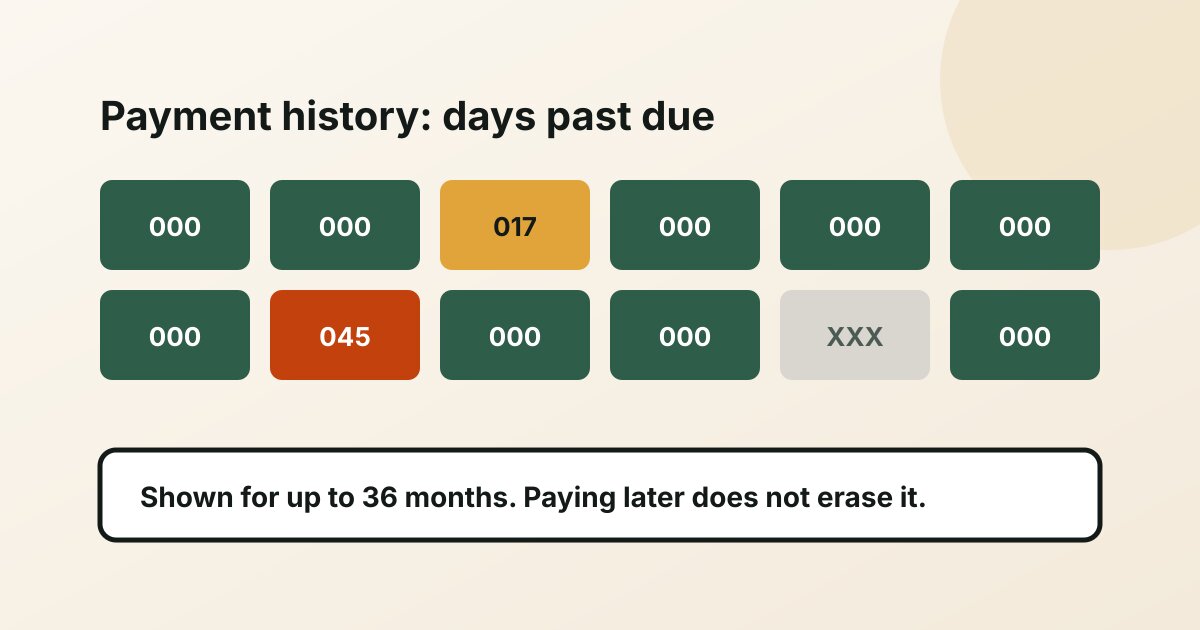
Short answer: DPD (days past due) is the number of days an EMI or credit card payment was late in a given month. "000" means paid on time; "030" means 30 days late. Your CIBIL report shows up to 36 months of this history for each account, so a correct late entry stays visible until it moves out of that window. Paying later does not erase it. A run of on-time months is what repairs it.
If a lender has told you "your DPD is the problem", this guide shows how to read the row, what each code means, how long an entry stays and what you can do about it this month.
What does DPD mean on a CIBIL report?
ICICI Bank describes DPD as the period during which a loan EMI or credit card payment goes past its due date. Every loan and card on your report has a payment history row, one cell per month. Each cell holds a three-digit number or a code:
- 000: paid on time that month.
- 001 to 999: the number of days the payment was overdue at the time the lender reported. Pay two days late and the cell can read 002.
- XXX: the lender did not send data for that month. Bajaj Finserv and Tata Capital both say this is not a default in itself.
- A letter code (STD, SMA, SUB, DBT, LSS): the account's classification instead of a day count.
TransUnion CIBIL says the report shows repayment history for up to the past 36 months. That 36-month grid is what lenders scan first.
What do STD, SMA, SUB, DBT and LSS mean?
These codes come from how banks classify loans under RBI's rules. Use the RBI definitions, not guesswork:
| Code | Meaning | How many days overdue (RBI) |
|---|---|---|
| STD | Standard: the account is regular | Not an NPA |
| SMA-0 | Special mention account: early stress | Up to 30 days |
| SMA-1 | Special mention account | More than 30, up to 60 days |
| SMA-2 | Special mention account | More than 60, up to 90 days |
| SUB | Substandard: a non-performing asset (NPA) | More than 90 days, NPA for up to 12 months |
| DBT | Doubtful | Substandard for 12 months |
| LSS | Loss: the lender does not expect to recover the money | Loss identified by the bank, auditors or RBI |
RBI's 12 November 2021 clarification says SMA classification applies to all loans, including retail loans such as personal loans, and that accounts are classified in the day-end process for each calendar date. So a personal loan EMI that is one day late is technically SMA-0 that night. An NPA account is upgraded to standard only when the entire arrears of interest and principal are paid, not part of them.
One caution: a few pages on the web expand LSS as "lender settled status". RBI, Tata Capital and Bajaj Finserv all use LSS for loss. A settled loan shows as "settled" in the account status, which our guide on settled vs closed explains.
A worked example: one EMI that slips
Ravi pays a ₹6,200 EMI due on the 5th of each month. In March 2026 his salary is delayed and he pays on the 22nd. In August he misses the EMI and pays it on 19 September, a few days before that month's EMI.
| Month | What happened | What the row can show |
|---|---|---|
| Jan, Feb 2026 | Paid on the 5th | 000, 000 |
| Mar 2026 | Paid on the 22nd | 017 |
| Apr to Jul 2026 | Paid on time | 000 |
| Aug 2026 | Not paid in August | about 026 at the month-end report |
| Sep 2026 | August EMI cleared on 19 Sep (45 days late); Sep EMI paid on time | 045 for the overdue EMI, then back to 000 |
| Oct 2026 onwards | Paid on time | 000 |
The exact number in each cell depends on the day the lender reports. Since 1 July 2026, RBI's amended directions require lenders to report credit information as on the 9th, 16th, 23rd and last day of each month, so a delay is picked up faster than it was under monthly or fortnightly reporting. Our guide on how often your CIBIL report is updated covers the reporting dates.
What Ravi's row tells a lender: one short slip (017), one delay past 30 days (045), then a clean run. The 045 matters more. Under RBI's buckets, that EMI was in SMA-1 for part of September. Had he not paid until early November (more than 90 days), the account would have become an NPA and shown SUB.
When do the entries stop showing? The March 2026 "017" stays in the 36-month grid until about March 2029, and the September "045" until about September 2029, as newer months push them out. Credit information is retained for at least seven years under the Credit Information Companies Regulations, 2006, so do not assume the record is deleted once it leaves the grid.
How long does DPD stay, and does paying remove it?
- A correct DPD is not removed when you pay. Bajaj Finserv puts it plainly: if the DPD entry is correct, you cannot remove it; the way forward is a run of on-time payments. Tata Capital says entries stay for up to 36 months from the month of delay even if dues are cleared later.
- CIBIL cannot edit it on its own. TransUnion CIBIL says it cannot delete or change records on its own and needs written confirmation from the lender.
- Older entries weigh less. Bajaj Finserv says one late month in 36 looks like a slip, and a single "030" followed by two years of "000" tells a lender you recovered.
- Long delays hurt most. ICICI Bank says delays beyond 30 to 60 days can cut a score by 50 to 300 points or more. Treat that as the bank's estimate.
What can you do about DPD on your report?
- Get your report and read every account's row. Look for any number other than 000, and for XXX on months you paid.
- If an entry is wrong, dispute it. CIBIL's dispute process lets you file online with proof such as the bank statement showing the EMI debit. Your report should be no more than 60 days old when you file, and the disputed field shows "Under Dispute" while it is checked. Under RBI's October 2023 framework, the lender gets 21 days and the bureau 9, and you are entitled to ₹100 a day if the correction takes longer than 30 days in total (from 26 April 2024, as CIBIL's compensation page states).
- If the entry is correct, stop the next one. Set up auto-debit a day or two after salary credit, keep a buffer of one EMI in the account, and call the lender before a due date you know you will miss.
- Clear anything overdue before it crosses 30, 60 and 90 days. Each bucket is a worse signal. An NPA needs all arrears paid before it is upgraded.
- If several EMIs are causing the delays, fix the cause. Missing payments because three or four EMIs leave on different dates is a cash-flow problem. One consolidation loan with one due date can stop the next DPD, while you are still on time. See does debt consolidation hurt your CIBIL score for what changes on your report when you do.
Avoid settling to "clean up" a DPD. A settlement does not remove past DPD; it adds a "settled" status that lenders see as risky. Closing a loan in full keeps the record cleaner.
Can you still get a loan with DPD on your report?
Often yes, but it depends on how recent, how long and how frequent the delays were, and on the lender's policy. A single short delay a year ago is very different from 60-plus days last month. If your score has slipped, our page on debt consolidation with a low CIBIL score explains which options are realistic and what lenders look at. More guides are in our debt consolidation guides hub.
How AdvanceCred can help
AdvanceCred is a credit advisory and loan intermediation firm in Mumbai. It is not a lender. If late EMIs are starting to show because you are juggling several loans, an advisor can compare consolidation options from partner banks and NBFCs while your record still has mostly 000s. AdvanceCred works on cases with up to 1 payday loan, up to 5 app and personal loans in total and up to 5 credit cards. The bank or NBFC decides approval, amount, rate and tenure.
Start with the loan-merge checker, see merge multiple EMIs into one, or leave your details below.
Sources
- ICICI Bank, "Days past due in CIBIL report" (DPD definition; even a one-day delay counts; delays beyond 30 to 60 days can cut a score by 50 to 300 points), checked 20 November 2026: icici.bank.in
- Bajaj Finserv, "How does CIBIL DPD impact your credit health" (000, XXX and asset codes; a correct DPD cannot be removed; one late month in 36), checked 20 November 2026: bajajfinserv.in
- Tata Capital, "Days past due in CIBIL report" (XXX is not a default; entries stay up to 36 months from the month of delay; modified 28 October 2026), checked 20 November 2026: tatacapital.com
- TransUnion CIBIL, FAQ brochure (payment history for the last 36 months; CIBIL cannot delete or change records on its own), checked 20 November 2026: cibil.com; walk-through of the accounts section: cibil.com
- TransUnion CIBIL, dispute resolution guide (report no older than 60 days; "Under Dispute" flag), checked 20 November 2026: cibil.com
- TransUnion CIBIL, Framework for compensation (30 days; ₹100 a day; from 26 April 2024), checked 20 November 2026: cibil.com
- Reserve Bank of India, Framework for compensation to customers for delayed updation/rectification of credit information, RBI/2023-24/72, 26 October 2023 (21 days for the lender, 9 for the bureau), checked 20 November 2026: rbi.org.in
- Reserve Bank of India, Prudential norms on IRACP: Clarifications, RBI/2021-2022/125, 12 November 2021 (SMA-0, SMA-1, SMA-2 for all loans including retail; day-end classification; NPA upgrade only on full arrears), checked 20 November 2026: rbi.org.in
- Reserve Bank of India, Master Circular on IRACP, RBI/2021-2022/104, 1 October 2021 (NPA over 90 days; substandard, doubtful and loss definitions), checked 20 November 2026: rbi.org.in
- Reserve Bank of India, Credit Information Companies (Amendment) Directions, 2025, 4 December 2025, in force from 1 July 2026 (credit information as on the 9th, 16th, 23rd and last day of each month), checked 8 November 2026: rbi.org.in
- Credit Information Companies Regulations, 2006, regulation 10(d) (credit information retained for a minimum of seven years), checked 20 November 2026: indiankanoon.org
- Worked example: illustrative dates and amounts, prepared by AdvanceCred, 20 November 2026.