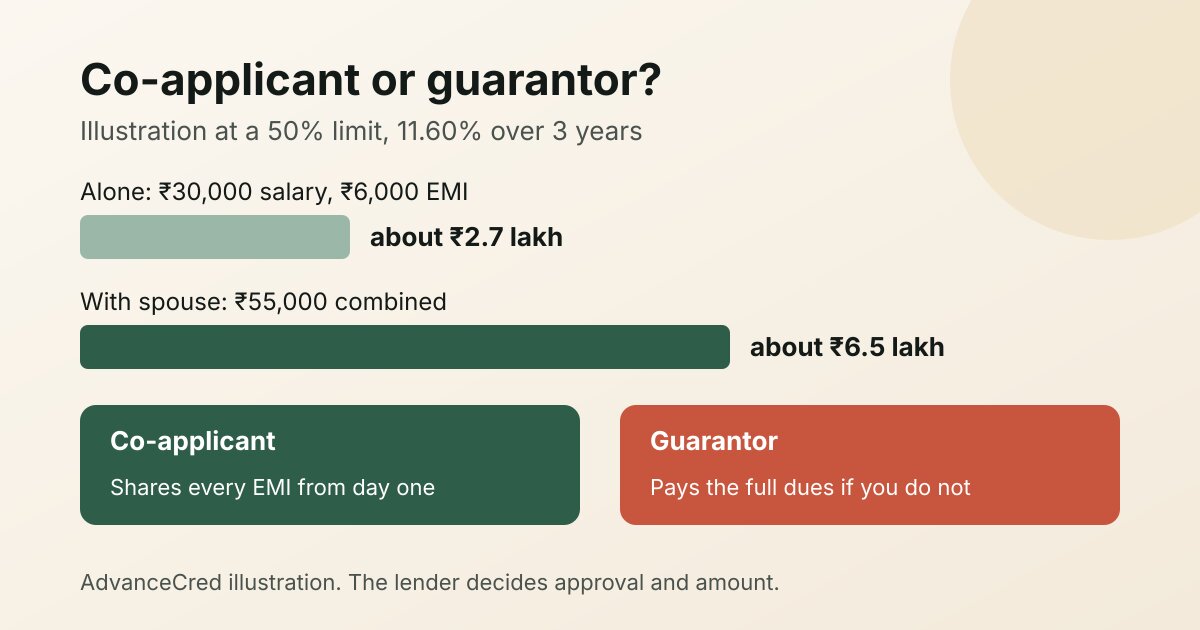
Short answer: yes, with some lenders. A co-applicant, usually a spouse or parent, adds their income to yours, so you can qualify for a larger amount. But both of you owe every EMI, and the loan affects both credit records. A guarantor does not get the money but must pay if you do not. Not every lender offers joint personal loans, so ask before you apply.
People look for a co-applicant when a single salary is not enough: a ₹25,000 take-home with one EMI running, a first job, or a score dented by one late payment. Adding someone can help. It also hands them a share of your debt, so it is worth understanding exactly what each role means.
Co-applicant or guarantor: what is the difference?
A co-applicant borrows with you and is responsible for the EMIs from the first day. A guarantor promises to pay only if you do not, but then owes the full amount, with interest and charges.
| Co-applicant (co-borrower) | Guarantor | |
|---|---|---|
| Gets the loan money | Shares the loan with you | No |
| Income counted for eligibility | Yes, combined with yours | Not usually the main test; the lender checks their ability to pay if needed |
| Pays the EMIs | Equally responsible from the start (ICICI Bank, Bajaj Finserv) | Only if you default, but then for the whole dues |
| Credit report | A joint loan affects both borrowers' history (SMFG India Credit) | The guaranteed loan can appear on the guarantor's report (Finnable) |
| Legal basis | Joint loan agreement | Contract of guarantee; liability co-extensive with the borrower's (Indian Contract Act, 1872, section 128) |
| Typical people | Spouse, parent, sometimes a sibling | Family member or someone the lender accepts |
Section 128 of the Indian Contract Act reads: "The liability of the surety is co-extensive with that of the principal debtor, unless it is otherwise provided by the contract." In plain words, a guarantor can be asked for the same amount you owe, including interest and charges.
Who can be a co-applicant on a personal loan?
Usually a close family member with a regular income. ICICI Bank names "spouse, parents, or guardians" as common co-applicants. Bajaj Finserv says lenders usually allow a spouse or parents, and some allow siblings. Poonawalla Fincorp says the spouse is generally the co-applicant. Friends are rarely accepted.
Two cautions:
- Not every lender offers it. SMFG India Credit says the joint personal loan option is not offered by all lenders. Ask before you apply, so you do not add a hard enquiry for a product that does not exist there.
- Their record counts too. A co-applicant with a good score and few EMIs helps; one with missed payments or heavy EMIs can hurt. ICICI Bank says a co-applicant's score does not improve yours, but a poor one "could affect your chances".
How much more can you borrow with a co-applicant?
Lenders add the two incomes and the two sets of EMIs, then check the share left for a new EMI. Most banks look for total EMIs within about 40% to 50% of income (see our FOIR guide).
Worked example: Rahul alone vs Rahul with his wife
Rahul takes home ₹30,000 a month and pays a ₹6,000 EMI. His wife Kavya takes home ₹25,000 and has no EMIs. Illustration at a 50% limit, 11.60% a year (ICICI Bank's mean rate for July to September 2026) over 3 years:
| Rahul alone | Rahul and Kavya together | |
|---|---|---|
| Monthly income | ₹30,000 | ₹55,000 |
| 50% of income | ₹15,000 | ₹27,500 |
| Existing EMIs | ₹6,000 | ₹6,000 |
| Room for a new EMI | ₹9,000 | ₹21,500 |
| Loan that EMI can repay (3 years at 11.60%) | about ₹2.7 lakh | about ₹6.5 lakh |
The joint application more than doubles the room. But Kavya now owes every EMI too. If Rahul loses his job, the lender can ask her for the full EMI, and a missed payment would show on her record as well as his. Your own lender may use a different limit, rate or income definition; this table only shows how combining incomes works.
If you only need a little more than you qualify for alone, a smaller amount or a longer tenure may be safer than adding someone. Check your own figure first with our eligibility calculator, and see the minimum salary for a personal loan if your income is near a lender's cut-off.
Before you agree to be a guarantor or co-applicant
- Assume you will pay. As a guarantor, plan as if the full EMI could become yours.
- Read the documents. The guarantee may continue until the loan is fully closed; Finnable notes that liability can arise during or after the loan term if dues remain.
- Know your own borrowing. Moneyview notes that a guarantor may find it harder to borrow because lenders see the guarantee as an obligation.
- Watch the account. Ask the borrower for the loan account number and check your own report once a year. Our guide to reading your CIBIL report shows where it appears.
- Get the closure letter. When the loan ends, make sure the account shows closed for both of you; see how to get a loan closure letter and NOC.
You cannot simply walk away. Whether a guarantor is released depends on the loan agreement and the lender's approval, Finnable says, and Moneyview adds that release usually needs a new guarantor or collateral.
When a co-applicant is the wrong fix
If you need a co-applicant because existing EMIs already take most of your salary, a new loan on top adds a fourth or fifth EMI to the household. Merging what you already owe into one EMI may solve the problem without new borrowing. See merging multiple EMIs into one and personal loan with existing loans.
How AdvanceCred can help
AdvanceCred is a credit advisory and loan intermediation firm in Mumbai. It is not a lender. An advisor can tell you which partner banks and NBFCs accept co-applicants on personal loans and how much your combined income may support, so you apply once at the right place. The lender decides approval, amount, rate and tenure. See our personal loan page, browse the guides hub, or leave your details below.
Sources
- ICICI Bank, Does a co-applicant affect personal loan eligibility? (co-applicant applies for a joint personal loan; common co-applicants spouse, parents or guardians; joint applications consolidate income; both share equal responsibility for EMIs; a co-applicant's score does not improve yours, a poor one could affect your chances; no absolute page date), checked 27 November 2026: icici.bank.in
- ICICI Bank, Personal loan interest rates (July to September 2026: 10.25% to 16.50%, mean 11.60%), checked 24 November 2026: icici.bank.in
- Bajaj Finserv, How a co-borrower can increase the chance of getting your personal loan approved (lenders usually allow spouse or parents; combined income; both equally responsible for EMIs; both scores may be affected by a missed payment; page metadata 16 November 2026), checked 27 November 2026: bajajfinserv.in
- SMFG India Credit, How a co-applicant's CIBIL score affects your personal loan approval (updated 4 November 2024; joint personal loan not offered by all lenders; a joint loan affects both borrowers' credit history), checked 27 November 2026: smfgindiacredit.com
- Poonawalla Fincorp, Personal loans for couples with a co-applicant (spouse generally the co-applicant; both incomes considered; no page date), checked 27 November 2026: poonawallafincorp.com
- Indian Contract Act, 1872, section 128, Surety's liability ("co-extensive with that of the principal debtor, unless it is otherwise provided by the contract"), checked 27 November 2026: lawx.in
- Finnable, Guarantor for personal loan: everything you should know before signing (updated 26 October 2026; guaranteed loan can appear on the guarantor's report; liability may arise during or after the loan term; release depends on the agreement and the lender), checked 27 November 2026: finnable.com
- Moneyview, What are the rules for loan guarantors? (guarantor liable under section 128; score affected by the borrower's default; may find it harder to borrow; release usually needs a new guarantor or collateral; no page date), checked 27 November 2026: moneyview.in
- Worked example (Rahul and Kavya are an illustration, not real customers): 50% limit per Kotak Mahindra Bank and IndusInd Bank FOIR guidance (see our FOIR guide); 11.60% is ICICI Bank's published mean rate. EMI per ₹1 lakh over 36 months at 11.60%: about ₹3,302. Prepared by AdvanceCred, 27 November 2026.