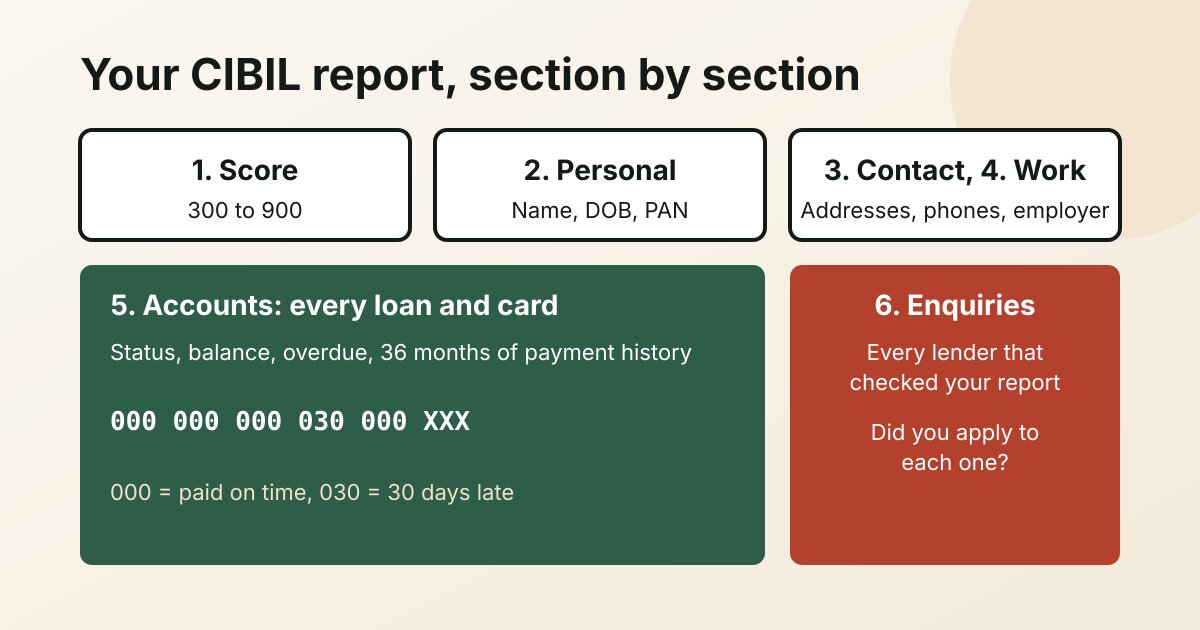
Short answer: a CIBIL report has six parts: your score (300 to 900), personal details, contact details, employment details, accounts and enquiries. The two that matter most are Accounts, which lists every loan and card with up to 36 months of payment history, and Enquiries, which lists every lender that checked your report. Check four things: every account is yours, every closed loan says closed, every late-payment entry is right, and every enquiry is one you made.
Most people only look at the three-digit score. The lender looks at the rows behind it. If a loan you closed two years ago still shows as active, or a card you never applied for shows up, your score and your next loan pay for it. This guide walks through the report one section at a time, with an example.
How do I get my report?
Every credit bureau must give you one free full credit report with your score once a calendar year, in electronic form, from its website after you verify your identity. RBI has required this since 1 January 2017 and, in its October 2023 customer-service directions, told bureaus to put the link on their home page. There are four bureaus (TransUnion CIBIL, Experian, Equifax and CRIF High Mark), so you can get four free reports a year, one from each.
Checking your own report does not lower your score. It is a soft enquiry. Only lenders' checks when you apply for credit count as hard enquiries.
Section 1: your CIBIL score
A number from 300 to 900; closer to 900 is better. Bajaj Finserv's guide calls 700 and above good and 650 and below low. No single score guarantees a loan: RBI does not set a minimum, and each lender uses its own cut-off together with your income and existing EMIs.
If you have no loans or cards, you may see NH (no history) or NA instead of a score. That is not a bad mark; it means there is not enough data yet.
Sections 2 to 4: personal, contact and employment details
These identify you. Check them first, because a wrong detail is often how someone else's loan ends up on your report.
| Section | What it holds | What to check |
|---|---|---|
| Personal information | Name, date of birth, gender, PAN and other ID numbers | Spelling, date of birth and PAN match your documents |
| Contact information | Addresses and phone numbers reported by lenders | No address or number you have never used |
| Employment information | Employer and income, as reported by lenders | Rarely complete; an old employer here is normal |
An unknown address next to an unknown loan is a warning sign of identity misuse. Dispute it straight away.
Section 5: accounts, the part lenders read most
One block for each loan and credit card, open or closed. According to TransUnion CIBIL, it shows the lender, the type of credit, the current balance and repayment history for up to the past 36 months. Each block typically has:
| Field | What it means | What to check |
|---|---|---|
| Member name | The lender that reported it | You know this lender |
| Account type | Personal loan, credit card, consumer loan, gold loan and so on | Matches your loan |
| Ownership | Individual, joint, guarantor or authorised user | A loan you guaranteed for someone else shows here too |
| Date opened, date closed | When it started and ended | A loan you closed has a closing date |
| Sanctioned amount or credit limit | Loan amount, or card limit | Matches your papers |
| Current balance | What was outstanding on the date reported | Zero on closed loans |
| Amount overdue | Unpaid dues on that date | Zero if you are up to date |
| Date reported | When the lender last sent data | Lenders now report four times a month, so this should be recent on open accounts |
| Status | Open, closed, or remarks such as settled, written off, restructured | No "settled" or "written off" you did not agree to |
| Payment history (DPD) | Days past due, month by month | 000 or STD each month you paid on time |
Days past due (DPD) is the heart of it: 000 means paid on time, a number such as 030 means that many days late, and XXX means the lender sent no data for that month. Our guide to DPD on a CIBIL report explains every code, including SMA, SUB and DBT.
A settled status is worse than closed: it tells the next lender you paid less than you owed. See settled vs closed on your CIBIL report.
Section 6: enquiries
Every time a lender checks your report because you applied for credit, it leaves an enquiry. TransUnion CIBIL says the section covers the last 36 months and each entry shows the lender, the date and the type of credit. Since RBI's October 2023 directions (in force six months later), bureaus must also send you an SMS or email when a lender pulls your report, if they have your number or email.
What to look for:
- Enquiries you did not make. They can mean someone applied in your name, or an app pulled your report without clear consent.
- Clusters. Five personal loan enquiries in a month tells a lender you were turned down elsewhere or are taking several loans at once. Space your applications.
A worked example: reading Rahul's report
Rahul, 29, earns ₹42,000 a month in Navi Mumbai. He is about to apply for a ₹3 lakh loan to close two app loans and a card. This is an illustrative report, not real data.
Accounts:
| Account | Status, balance, overdue | DPD, last 6 months (newest first) |
|---|---|---|
| Bank A credit card, limit ₹80,000 | Open; ₹72,000; ₹0 overdue | 000 000 000 000 000 000 |
| NBFC B personal loan, ₹1.5 lakh | Closed March 2026; ₹0 | (closed) |
| NBFC C consumer loan, ₹40,000 | Open; ₹18,000; ₹3,100 overdue | 032 000 000 XXX 000 000 |
| App lender D personal loan, ₹25,000 | Open; ₹25,000; ₹0 overdue | 000 000 |
What Rahul reads from it:
- The card is nearly maxed out. ₹72,000 of ₹80,000 is 90% of the limit. High use weighs on the score even though every payment was on time.
- The NBFC B loan is correctly closed. If it had still shown "open", he would dispute it with his closure letter (how to get one).
- NBFC C shows a late payment and ₹3,100 overdue right now. The 032 is last month. Paying the overdue before he applies matters more than anything else here; the entry itself stays, but a current overdue makes a rejection likely.
- The XXX four months ago just means no data was sent; it is not a default.
- App lender D is new (only two months of history).
Enquiries: four personal loan enquiries in the last 60 days, three from apps he only browsed. He stops applying for 2 to 3 months, raises a dispute about one enquiry he does not recognise, and pays the NBFC C overdue.
Then the plan. With the card at ₹72,000, NBFC C at ₹18,000 and the app loan at ₹25,000, he owes about ₹1.15 lakh, not ₹3 lakh. One loan of that size would close all three; he asks for that amount, not more. Our loan-merge checker does this sum with your own numbers.
Found a mistake? How to get it fixed
- Download a fresh report. TransUnion CIBIL asks for a report no older than 60 days when you raise a dispute.
- Raise the dispute on the CIBIL website (the entry is marked "Under Dispute" while it is checked), or directly with the lender that reported it.
- Attach proof: the closure letter or NOC, payment receipts, or a police complaint if it is fraud.
- Know the clock. Under RBI's compensation framework, the lender has 21 days and the bureau 9 days, 30 days in all. After that you are owed ₹100 for each calendar day of delay.
- Check again after the next reporting date. Lenders now report four times a month (see how often your CIBIL report is updated).
A correct late payment cannot be removed by a dispute, and paying to "clean" your report is a scam. What works is time and on-time EMIs.
When your report shows too many loans
If your accounts section has several open app loans, a card near its limit and recent DPD entries, a new loan on top will make it worse. One loan that closes several, at a lower rate, can cut your EMIs and your card use at once. AdvanceCred handles cases with up to 1 payday loan, up to 5 app and personal loans in total, and up to 5 credit cards; the lender still decides approval. See how to merge multiple EMIs into one, or debt consolidation with a low CIBIL score if your score is already down.
How AdvanceCred can help
AdvanceCred is a credit advisory and loan intermediation firm in Mumbai. It is not a lender. Our advisors read your report with you, point out what lenders will notice, and only then match you to partner banks and NBFCs whose rules you meet. The lender decides approval, amount, rate and tenure.
Browse more in the debt consolidation guides hub, or leave your details below.
Sources
- TransUnion CIBIL, Walk-through: reading the accounts and enquiries sections of your CIBIL report (accounts: lender, type of credit, current balance, repayment history for up to 36 months, DPD and account status; enquiries: last 36 months, lender, date, type of credit), checked 22 November 2026: cibil.com
- IIFL Finance, How to read your CIBIL report: section-by-section guide, 14 May 2026 (six sections; account fields including ownership, date opened, amount overdue and DPD grid; own check is a soft enquiry; no RBI-prescribed minimum cut-off), checked 22 November 2026: iifl.com
- Bajaj Finserv, How to read your CIBIL report (score 300 to 900; 700 and above good, 650 and below low), checked 22 November 2026: bajajfinserv.in
- HDFC Bank, How to interpret your CIBIL report, 24 August 2026 (account ownership, dates, date last reported, current balance, status such as settled or written off, DPD), checked 22 November 2026: hdfc.bank.in
- Reserve Bank of India, Free full credit report, DBR.CID.BC.No.10/20.16.042/2016-17, 1 September 2016 (one free full credit report with score per calendar year, electronic, from 1 January 2017), checked 22 November 2026: rbi.org.in
- Reserve Bank of India, Strengthening of customer service rendered by Credit Information Companies and Credit Institutions, RBI/2023-24/73, 26 October 2023 (SMS or email alert to customers when their report is accessed; free report link on the bureau's home page; in force six months from the circular), checked 22 November 2026: rbi.org.in
- Reserve Bank of India, Framework for compensation to customers for delayed updation/rectification of credit information, RBI/2023-24/72, 26 October 2023 (21 days for the lender, 9 for the bureau; ₹100 a day after 30 days), checked 20 November 2026: rbi.org.in
- TransUnion CIBIL, A guide to the CIBIL dispute resolution process (report no older than 60 days; "Under Dispute" flag), checked 20 November 2026: cibil.com
- Reserve Bank of India, Credit Information Companies (Amendment) Directions, 2025, 4 December 2025, in force from 1 July 2026 (credit information reported as on the 9th, 16th, 23rd and last day of each month), checked 8 November 2026: rbi.org.in
- Business Standard, CIBIL score not mandatory: govt tells banks not to reject first-time loans, 25 August 2025 (Minister of State for Finance in the Lok Sabha: RBI has not prescribed a minimum credit score), checked 22 November 2026: business-standard.com
- Tata Capital, How to get an instant loan without a CIBIL score, modified 2 November 2026 (an "NH" remark explains credit inactivity), checked 22 November 2026: tatacapital.com
- Worked example: illustrative report and profile, prepared by AdvanceCred, 22 November 2026.
This article is general information, not financial advice. Report layouts differ slightly between the four bureaus; the fields above are the common ones.