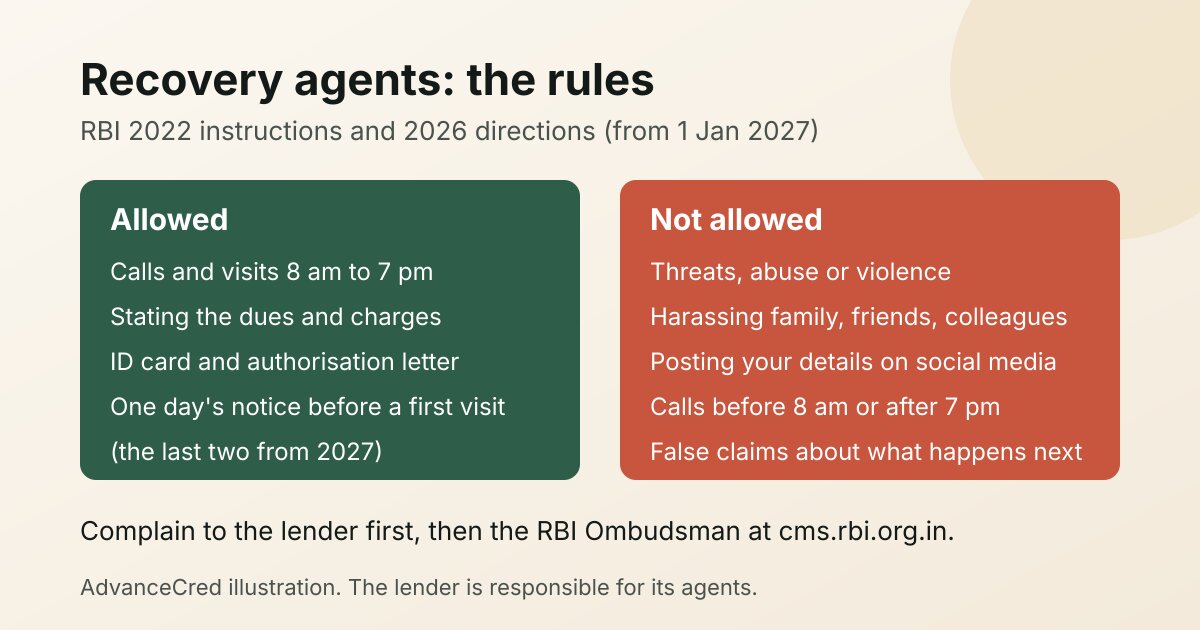
Short answer: a recovery agent working for a bank, NBFC or loan app may call or visit only between 8 am and 7 pm, must not threaten, abuse or shame you, and must not harass your family, friends, referees or colleagues. RBI's new directions, in force from 1 January 2027, add an identity card and authorisation letter on every visit, one day's notice before the first visit, recorded calls and a public list of the lender's agencies. Whatever the agent does, the lender is responsible.
You still owe the money. The rules do not cancel a loan or stop a lender from recovering what is due, through calls, visits, notices or the courts. They set how it may be done. Knowing them helps you deal with calls calmly and complain when a line is crossed.
What are the rules today, and what changes on 1 January 2027?
Two sets of RBI rules matter. The 12 August 2022 instructions on recovery agents apply now. On 6 August 2026 RBI issued final amendment directions, "Conduct of Regulated Entities in Recovery of Loans and Engagement of Recovery Agents", for commercial banks, small finance banks, co-operative banks, regional rural banks, NBFCs, housing finance companies and others. They take effect on 1 January 2027 and replace the older recovery paragraphs.
| Rule | Today (RBI, 12 August 2022) | From 1 January 2027 (RBI, 6 August 2026) |
|---|---|---|
| Calling hours | No recovery calls before 8 am or after 7 pm | Calls and visits only between 08:00 and 19:00, unless you ask otherwise |
| Threats and harassment | No intimidation or harassment of any kind, verbal or physical | Same, plus a list of conduct "deemed as harsh" (below) |
| Family, friends and colleagues | No intrusion on the privacy of family members, referees and friends | No harassment of relatives, referees, friends or co-workers; dues discussed only with the borrower or guarantor |
| Identity | Not spelt out in the 2022 instructions | Identity card, authorisation letter and the lender's notice on every visit |
| Notice before a visit | Not spelt out | Agency details given to you at least one day before the first in-person visit |
| Calls recorded | Not spelt out | Call times and numbers logged and call content recorded, kept for six months; you are told the call is recorded |
| Who the agents are | Not spelt out | Lender publishes its list of recovery agencies on its website, updated within seven days of any change |
| Agent training | Not spelt out | Agents need the IIBF Debt Recovery Agents certificate or an equivalent |
What recovery agents cannot do
RBI's 2026 directions list eight kinds of conduct "deemed as harsh". In plain words, an agent must not:
- Use threatening or abusive language.
- Post your recordings or personal details on social media.
- Send inappropriate messages.
- Call too often, or outside 8 am to 7 pm.
- Make threatening or anonymous calls.
- Intimidate or harass you, your relatives, referees, friends or co-workers, or try to humiliate you publicly.
- Use or threaten violence.
- Make false or misleading claims about what you owe or what will happen if you do not pay, for example that you will be arrested tomorrow.
The 2022 instructions already ban intimidation and harassment of any kind, threatening or anonymous calls, inappropriate messages and false or misleading representations, so most of this list applies to you today.
What recovery agents can do
- Call you between 8 am and 7 pm about the overdue amount, at a reasonable frequency.
- Visit you within the same hours. From 2027 they must show the agency's identity card, an authorisation letter and a copy of the lender's notice, each with the agency's phone number and the grievance officer's details.
- Tell you the facts: the overdue amount, the charges, the effect on your credit report, and that the lender may take legal steps.
- Accept payment through the lender's official channels. Pay only to the lender's own account or app and keep the receipt; ask for a receipt on the lender's letterhead if you pay an agent in person.
What does a missed EMI actually lead to?
Calls start soon after a missed EMI, but the account's status on your credit report is what lasts. Each month you stay overdue adds to the days past due (DPD) shown on your report, and after 90 days most loans are classed as non-performing. Our guide to DPD on a CIBIL report explains the codes. Settling for less than the dues ends the calls but leaves a "settled" mark that lenders read for years, as our settled vs closed guide shows.
Worked example: a call log that supports a complaint
Ravi, a salaried borrower in Pune, missed two EMIs on an app loan. Over three days he noted every call:
| Date and time | Number | What was said | Rule it breaks |
|---|---|---|---|
| 3 Dec, 7:40 am | +91 9xxxx xxx12 | Asked for payment | Before 8 am |
| 3 Dec, 9:15 pm | +91 9xxxx xxx47 | Abusive language | After 7 pm; abusive language |
| 4 Dec, 11:00 am | His manager's desk phone | Told the manager about the loan | Harassing a co-worker; dues discussed with someone other than the borrower |
| 5 Dec, 2:30 pm | Threat to post his photo "to all contacts" | Threat to shame on social media |
He sent this table to the lender's grievance officer by email on 6 December and kept the screenshots. A log like this, with times, numbers and words used, is what a grievance officer or the Ombudsman needs to act. At the same time he paid what he could and asked the lender in writing for a revised schedule, because a complaint about conduct does not pause the dues.
How to complain about a recovery agent
- Write to the lender's grievance officer. Their name and contact must be shown on the lender's website, in the app and in your Key Facts Statement; from 2027 also on every recovery notice. Give dates, times, numbers and what was said. The lender, not the agency, answers for its agents.
- Go to the RBI Ombudsman at cms.rbi.org.in if the lender rejects your complaint or does not reply within 30 days. The Reserve Bank Integrated Ombudsman Scheme, 2026 covers banks and NBFCs. RBI's helpline is 14448.
- Threats of violence, or morphed photos: go to the police, and report on the National Cybercrime Reporting Portal (cybercrime.gov.in) or by calling 1930.
- An app with no regulated lender behind it is not covered by these rules at all. Check it with our guide to whether a loan app is RBI-registered and report it on the cybercrime portal.
How to stop the calls for good
Complaints stop bad conduct; only a repayment plan stops the calls. If the calls come from several app loans at once, look at the whole picture:
- List every loan, its EMI and due date. Pay the smallest overdue amounts first so fewer accounts are in default.
- Do not borrow from a new app to pay an old one. Our worked example of taking a loan from one app to repay another shows how fast that grows.
- Ask about one loan to close the others. If your salary can carry one EMI, a single personal loan from a bank or NBFC can close several app loans before they reach 90 days overdue. See app and payday loan consolidation and merging multiple EMIs into one.
How AdvanceCred can help
AdvanceCred is a credit advisory and loan intermediation firm in Mumbai. It is not a lender and not a recovery agency, and it cannot stop a lender's lawful recovery. An advisor can review your loans and credit report and check whether a single loan from a partner bank or NBFC could close the costly ones. AdvanceCred works on consolidation cases with up to 1 payday loan, up to 5 app and personal loans in total and up to 5 credit cards. The lender decides approval, amount, rate and tenure.
Browse the guides hub, try the free loan-merge check on app loan consolidation, or leave your details below.
Sources
- Reserve Bank of India, press release 2026-2027/827, "RBI Issues Amendment Directions on 'Conduct of Regulated Entities in Recovery of Loans and Engagement of Recovery Agents'", 6 August 2026 (final directions after drafts of 12 February and 20 May 2026; effective 1 January 2027; nine sets of directions from commercial banks to NBFCs and HFCs), checked 25 November 2026: rbi.org.in
- Reserve Bank of India, Reserve Bank of India (Commercial Banks – Responsible Business Conduct) Fourth Amendment Directions, 2026, RBI/2026-27/223, 6 August 2026 (para 454I IIBF certificate; 454K agency list updated within seven calendar days; 454L notice at least one day before the first visit; 454P call records kept six months; 454X identity card, authorisation letter and notice; 454Y contact 08:00 to 19:00 and dues discussed only with the borrower or guarantor; 454Z conduct deemed harsh; 454AA recovery grievance mechanism; 454F compensation), checked 25 November 2026: rbi.org.in
- Reserve Bank of India, Responsibilities of regulated entities employing Recovery Agents, RBI/2022-23/108, 12 August 2022 (no intimidation or harassment; no intrusion on the privacy of family members, referees and friends; no calls before 8 am or after 7 pm; no threatening or anonymous calls or false representations), checked 18 November 2026: rbi.org.in; reported by Business Standard (PTI), 12 August 2022: business-standard.com
- Reserve Bank of India, Reserve Bank Integrated Ombudsman Scheme, 2026, FAQ (complain to the entity first and wait 30 days; cms.rbi.org.in; helpline 14448), checked 24 November 2026: rbi.org.in
- Government of India, National Cybercrime Reporting Portal and 1930 helpline: cybercrime.gov.in
- Worked example (Ravi): an illustration built by AdvanceCred to show how to log calls, 25 November 2026; it is not a real customer.