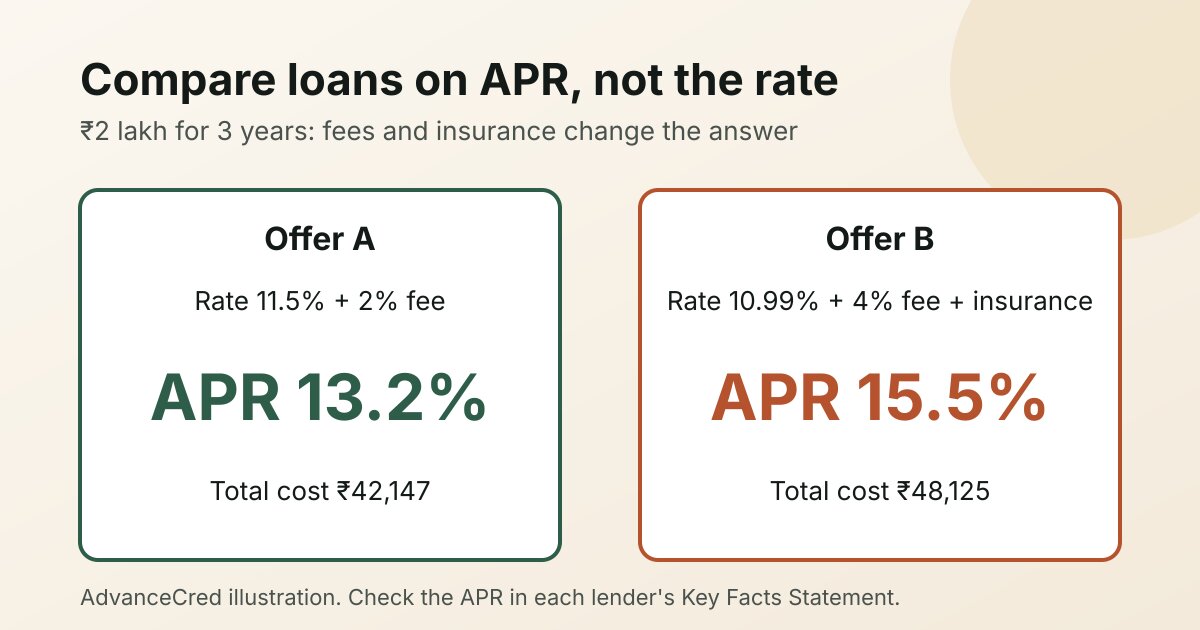
Short answer: a Key Facts Statement (KFS) is the standard summary of a loan that every bank and NBFC must give you before you sign a retail or MSME term loan. The number to look at first is the APR (annual percentage rate): the yearly cost of the loan including interest and every charge. Compare two offers on APR and total cost, not on the headline interest rate, because a lower rate with a bigger fee or bundled insurance can cost you more.
Loan offers are usually sold on one number: "from 10.99%". The KFS is where the full price sits. This guide explains what it must contain, what RBI says about it, and how to use it to pick the cheaper of two offers.
What is a Key Facts Statement?
A KFS is a short, standard-format document that sets out a loan's main terms in plain language. RBI made it compulsory for all retail and MSME term loans sanctioned on or after 1 October 2024, including fresh loans to existing customers, by banks, co-operative banks and NBFCs (including housing finance companies). Credit card dues are not covered.
The KFS must:
- be in a language you understand, explained to you, and acknowledged by you;
- carry a unique proposal number;
- show the loan amount, interest rate, EMI, tenure and every fee and charge;
- include an APR computation sheet and the repayment (amortisation) schedule;
- appear as a summary box in the loan agreement too.
The rules started in RBI's circular of 15 April 2024. Since November 2025 they sit in RBI's consolidated Responsible Business Conduct Directions for banks (paragraph 348) and for NBFCs (paragraph 29). The rights below are the same in both.
What is APR, and why is it higher than the interest rate?
APR is the annual cost of credit to you. It counts the interest rate plus all charges the lender levies, such as the processing fee. Charges the lender collects for someone else, such as insurance premiums or legal fees, are also part of the APR and must be shown separately in the KFS, with receipts given to you.
The interest rate tells you how your EMI is worked out. The APR tells you what the money really costs, because fees and insurance are usually taken out of the loan before it reaches your account. You repay EMIs on the full loan but receive less, so your real cost is higher than the rate.
RBI's own illustration shows the gap: a ₹20,000 loan over 24 months at 15% with ₹400 of fees has an EMI of ₹970 and an APR of 17.07%, two points above the rate.
Your rights under the KFS rules
| Rule | What it means for you |
|---|---|
| KFS before signing | You get the full terms before you commit, not after disbursal |
| Valid for at least 3 working days (1 day for loans under 7 days) | Time to compare; the lender is bound by the KFS terms if you accept in that window |
| No charges outside the KFS | A fee not listed in the KFS cannot be charged at any stage without your explicit consent |
| Third-party charges shown separately | Insurance and legal fees collected by the lender are counted in the APR, with receipts |
| Copy sent to you (digital loans) | The KFS and signed documents must reach your verified email or SMS automatically |
| Cooling-off period (digital loans) | At least one day in which you can exit by paying back the principal and proportionate APR, with no penalty |
Lending apps that show offers from several lenders must also show each lender's name, amount, tenure, APR, monthly repayment and penal charges, with a link to that lender's KFS, so you can compare fairly.
Worked example: the lower rate is the costlier loan
You need ₹2 lakh for 3 years and have two offers:
- Offer A: 11.5% a year, processing fee 2% plus 18% GST.
- Offer B: 10.99% a year, processing fee 4% plus 18% GST, and ₹3,000 of loan insurance deducted from the loan.
Both lenders deduct the charges before paying out, and the first EMI falls a month later.
| Offer A | Offer B | |
|---|---|---|
| Interest rate | 11.50% | 10.99% |
| EMI | ₹6,595 | ₹6,547 |
| Total interest over 36 months | ₹37,427 | ₹35,685 |
| Processing fee + GST | ₹4,720 | ₹9,440 |
| Insurance | nil | ₹3,000 |
| Money that reaches your account | ₹1,95,280 | ₹1,87,560 |
| APR | about 13.2% | about 15.5% |
| Total cost (interest + upfront charges) | ₹42,147 | ₹48,125 |
Offer B's rate is half a point lower and its EMI ₹48 smaller, yet it costs about ₹5,980 more and you receive ₹7,720 less. Its APR is more than two points higher. The KFS shows all of this on one page, which is why APR, not the rate, is the number to compare.
The APR here is worked out the way RBI's illustration does it: the monthly rate at which 36 EMIs equal the money you actually receive, multiplied by 12. If the insurance is optional, ask for the KFS without it and compare again.
How to compare two loan offers, step by step
- Ask each lender for the KFS before you share OTPs or sign anything. A lender that will not give one before signing is a red flag.
- Check that the loan amount and tenure match across offers. APRs are only comparable for the same amount and tenure.
- Compare APR first, then the total amount you will repay and the money that reaches your account.
- Read the charges list: processing fee, insurance, stamp duty, foreclosure and part-payment charges, bounce and penal charges. Our foreclosure charges by bank guide shows how much closing early costs at seven lenders.
- Check the rate type. Most personal loans are fixed-rate. On a floating-rate loan to an individual sanctioned from 1 January 2026, RBI does not allow pre-payment charges.
- Check who the lender is. On an app, the KFS must name the bank or NBFC. Our guide on how to check if a loan app is RBI-registered shows how.
- Use the 3-day window. You do not need to accept on the call. If an offer will not wait, it is usually the wrong offer.
A very short loan with a flat fee can have an APR of over 100%, even when the "interest" sounds small. Our guide to loans without a CIBIL check works through a ₹10,000 app loan at about 176% APR.
How AdvanceCred can help
AdvanceCred is a credit advisory and loan intermediation firm in Mumbai. It is not a lender. When you are weighing a new personal loan or one loan to clear several EMIs, an advisor can compare offers from partner banks and NBFCs on APR and total cost, and explain each KFS line by line. AdvanceCred works on cases with up to 1 payday loan, up to 5 app and personal loans in total and up to 5 credit cards. The lender decides approval, amount, rate and tenure.
Try the loan-merge checker, browse the debt consolidation guides hub, or leave your details below.
Sources
- Reserve Bank of India, Key Facts Statement (KFS) for Loans & Advances, RBI/2024-25/18, DOR.STR.REC.13/13.03.00/2024-25, 15 April 2024 (scope, 1 October 2024 start, APR definition, third-party charges, validity of 3 and 1 working days, no charges outside the KFS), checked 23 November 2026: rbi.org.in
- Reserve Bank of India, Commercial Banks – Responsible Business Conduct Directions, 2025, RBI/2025-26/170, 28 November 2025, updated 1 October 2026 (para 4 APR definition; para 348 KFS rules; illustration of ₹20,000 over 24 months at 15%, EMI ₹970, APR 17.07%), checked 23 November 2026: rbi.org.in
- Reserve Bank of India, Non-Banking Financial Companies – Responsible Business Conduct Directions, 2025, RBI/DOR/2025-26/362, 28 November 2025 (paras 6 and 29, KFS and APR for NBFCs), checked 23 November 2026: rbi.org.in
- Reserve Bank of India, Commercial Banks – Credit Facilities Directions, 2025, RBI/DOR/2025-26/154, updated 1 October 2026 (digital lending: para 7 multi-lender apps, para 9 KFS copy to the borrower, para 11 cooling-off period of at least one day), checked 23 November 2026: rbi.org.in
- Reserve Bank of India, Digital Lending Directions, 2025, RBI/2025-26/36, 8 May 2025 (where the cooling-off and multi-lender rules started), checked 23 November 2026: rbi.org.in
- Reserve Bank of India, Pre-payment Charges on Loans Directions, 2025, RBI/2025-26/64, 2 July 2025, checked 23 November 2026: rbi.org.in
- Bajaj Finance, Personal loan fees and charges (APR "the yearly cost of a loan, including the processing fee and other charges"; check the loan offer and KFS for the final disbursal amount), checked 23 November 2026: bajajfinserv.in
- Worked example: offers are illustrations, not quotes from a named lender. EMI by the standard reducing-balance formula; APR as monthly IRR × 12, the method that reproduces RBI's 17.07% illustration. Calculated by AdvanceCred, 23 November 2026.