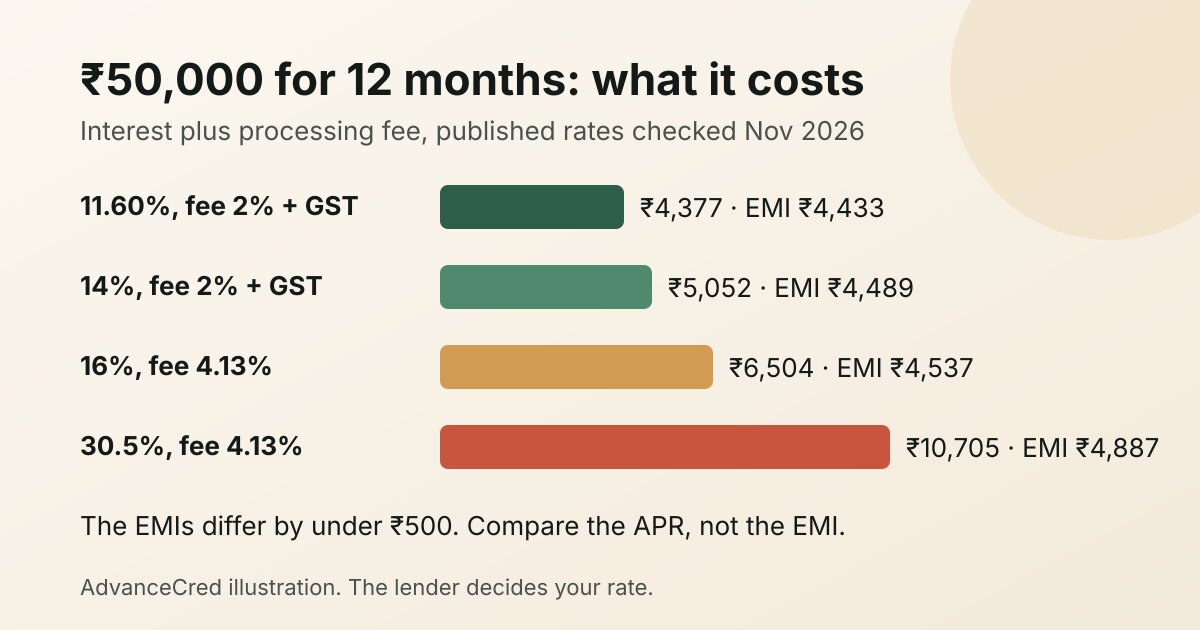
Short answer: over 12 months, a ₹50,000 personal loan costs about ₹4,000 to ₹4,400 at bank rates of 10.25% to 11.60% with a 2% fee plus GST, and up to about ₹10,700 at an app lender's top published rate of 30.5% with a 4.13% fee. The EMI looks similar either way, ₹4,400 to ₹4,900 a month, so it hides the difference. The processing fee and the rate decide what you really pay, and the APR in the Key Facts Statement shows both in one number.
₹50,000 is one of the most common amounts people borrow in a hurry: a hospital deposit, a rent advance, a gap before salary. That urgency is exactly when people accept the first offer on their phone. Five minutes of comparison can save several thousand rupees.
What do lenders publish for a ₹50,000 loan?
Published ranges for salaried borrowers differ widely, and every lender decides your rate from your income, employer and credit report. These are the lenders' own published figures:
| Lender | Interest rate (per year) | Processing fee | Amount and tenure | Checked |
|---|---|---|---|---|
| HDFC Bank | 10.25% to 24% (salaried) | Up to ₹6,500 plus GST | Not on the rate page | 15 Nov 2026 |
| ICICI Bank | 10.25% to 16.50% (mean 11.60%, Jul to Sep 2026) | Up to 2% plus taxes | ₹50,000 to ₹50 lakh; 12 to 84 months | 24 Nov 2026 (rates), 15 Nov 2026 (amount) |
| Moneyview (app; loans from its partner lenders) | From 14% | From 2% of the approved amount | Loan calculator from ₹5,000 and 3 months | 25 Nov 2026 |
| Bajaj Finance Insta Personal Loan | 16% to 30.5% | Up to 4.13%, taxes included | ₹40,000 to ₹15.5 lakh; 12 to 96 months | 25 Nov 2026 |
"From" and "up to" matter. Moneyview publishes only a starting rate, so your offer may be higher. HDFC Bank's fee is a ceiling in rupees; on a small loan, ask what it will actually be.
What does ₹50,000 cost over 12 months?
At the same ₹50,000 and 12 months, the total cost runs from about ₹2,800 plus the fee to about ₹10,700. EMI by the standard reducing-balance formula; fees at the published maximum or starting level; APR includes the fee:
| Example offer | EMI | Interest | Fee | Total cost | APR |
|---|---|---|---|---|---|
| HDFC Bank's lowest rate, 10.25%, fee not counted | ₹4,402 | ₹2,819 | Ask | ₹2,819 + fee | 10.25% + fee |
| ICICI Bank's mean rate, 11.60%, fee 2% + 18% GST | ₹4,433 | ₹3,197 | ₹1,180 | ₹4,377 | 16.2% |
| ICICI Bank's top rate, 16.50%, fee 2% + 18% GST | ₹4,548 | ₹4,581 | ₹1,180 | ₹5,761 | 21.1% |
| Moneyview's starting rate, 14%, fee 2% + 18% GST | ₹4,489 | ₹3,872 | ₹1,180 | ₹5,052 | 18.6% |
| Bajaj Finance's lowest rate, 16%, fee 4.13% | ₹4,537 | ₹4,439 | ₹2,065 | ₹6,504 | 24.2% |
| Bajaj Finance's top rate, 30.5%, fee 4.13% | ₹4,887 | ₹8,640 | ₹2,065 | ₹10,705 | 39.0% |
Two things stand out. The EMIs differ by less than ₹500 a month, yet the total cost differs by more than ₹6,000. And the fee lifts the APR far above the interest rate on a small, short loan: a 2% fee plus GST turns 11.60% into about 16.2%. Our guide to the Key Facts Statement and APR explains how lenders must show this number. Moneyview's page does not say whether GST is added to its fee; the row assumes it is.
The fee usually comes out of the money you receive. On a ₹50,000 loan with a 4.13% fee you get about ₹47,935 in your account but repay EMIs on the full ₹50,000. If you need ₹50,000 in hand, ask for the net amount in writing.
Does a longer or shorter tenure cost less?
A longer tenure lowers the EMI but costs more in rupees; a shorter one costs less in rupees but shows a higher APR. Same ₹50,000:
| Rate and fee | 6 months | 12 months | 24 months |
|---|---|---|---|
| 11.60%, fee ₹1,180 | Not offered by ICICI Bank (12 months minimum) | EMI ₹4,433; cost ₹4,377; APR 16.2% | EMI ₹2,344; cost ₹7,444; APR 14.0% |
| 14%, fee ₹1,000 (2%, no GST) | EMI ₹8,677; cost ₹3,061; APR 21.1% | EMI ₹4,489; cost ₹4,872; APR 17.9% | Not calculated |
| 30.5%, fee ₹2,065 | Not offered by Bajaj Finance (12 months minimum) | EMI ₹4,887; cost ₹10,705; APR 39.0% | EMI ₹2,809; cost ₹19,470; APR 35.1% |
So choose the shortest tenure whose EMI you can pay every month without borrowing again. A loan that is cheap on paper but leaves you short before the next salary often ends with a second loan. That is how many people end up with five EMIs; see how app loans drain even a high salary.
Bank or app: which should you choose for ₹50,000?
- Try your salary-account bank first. It sees your income every month and may have a pre-approved offer; read what a pre-approved loan really means. ICICI Bank's loans start at exactly ₹50,000.
- If you use an app, use a regulated lender's app. Moneyview and Bajaj Finance publish their rates and fees. Before borrowing from any app, check the lender behind it with our guide to whether a loan app is RBI-registered.
- Avoid 30-day payday loans for amounts like this. Their fees, spread over a month, give APRs far above anything in the tables above. See why you should never take a payday loan.
- Read the other charges. Moneyview lists ₹500 per bounced EMI and penal interest of 24% a year on overdue EMIs; Bajaj Finance lists ₹700 per bounce, penal charges of up to 36% a year and 4.72% (taxes included) for full prepayment. One bounced EMI can wipe out the saving from a lower rate.
Worked example: same need, two choices
Priya, a salaried employee earning ₹32,000 a month, needs ₹50,000 for a family medical bill. She has two offers on her phone for 12 months:
| Offer A: salary-account bank | Offer B: app lender | |
|---|---|---|
| Rate | 11.60% | 30.5% |
| Fee | 2% + 18% GST = ₹1,180 | 4.13% = ₹2,065 |
| Money received | ₹48,820 | ₹47,935 |
| EMI | ₹4,433 | ₹4,887 |
| Total paid back | ₹53,197 | ₹58,640 |
| Total cost (interest + fee) | ₹4,377 | ₹10,705 |
Offer B costs her ₹6,328 more for the same ₹50,000, and gives her ₹885 less in hand. The EMI gap is only ₹454 a month, which is why it is easy to miss. Both EMIs are about 14% to 15% of her salary, so either fits; the cheaper one is clearly better if the bank approves her in time.
If ₹50,000 is to repay other loans
If you are borrowing ₹50,000 to clear app loans or a card bill, a new small loan may only add one more EMI. When you already have several, it can be better to replace them all with one larger loan whose EMI fits your salary. Our guide to merging multiple EMIs into one explains how, and instant personal loans for salaried employees shows what lenders ask for.
How AdvanceCred can help
AdvanceCred is a credit advisory and loan intermediation firm in Mumbai. It is not a lender. An advisor can check which partner banks and NBFCs your salary and credit report fit, so you apply once and compare offers on their APR, not their EMI. AdvanceCred also works on consolidation cases with up to 1 payday loan, up to 5 app and personal loans in total and up to 5 credit cards. The lender decides approval, amount, rate and tenure.
Check how much you can borrow on your salary, browse the guides hub, or leave your details below.
Sources
- ICICI Bank, Personal loan interest rates (July to September 2026: 10.25% to 16.50%, mean 11.60%; processing fee up to 2% plus taxes), checked 24 November 2026: icici.bank.in; Personal loan (₹50,000 to ₹50 lakh; 12 to 84 months), checked 15 November 2026: icici.bank.in
- HDFC Bank, Personal loan interest rates and charges (salaried 10.25% to 24.00%; processing fee up to ₹6,500 plus GST), checked 15 November 2026: hdfc.bank.in
- Moneyview, Personal loan interest rates and charges (starting from 14% a year for loans from partner lenders; processing fee starts at 2% of the approved amount; penal charge 24% a year plus taxes on overdue EMIs; ₹500 per NACH bounce; calculator from ₹5,000 and 3 months; no page date), checked 25 November 2026: moneyview.in
- Bajaj Finance, Insta Personal Loan (16% to 30.5% a year; processing fee up to 4.13% inclusive of taxes; ₹40,000 to ₹15,50,000; 12 to 96 months; ₹700 per bounce; penal charges up to 36% a year; full prepayment 4.72% inclusive of taxes; stamp duty as per state law), checked 25 November 2026: bajajfinserv.in
- Reserve Bank of India, Key Facts Statement for Loans and Advances, RBI/2024-25/18, 15 April 2024 (APR includes interest and all charges; KFS before you sign), checked 23 November 2026: rbi.org.in
- Worked examples (Priya is an illustration, not a real customer): EMI by the standard reducing-balance formula; APR as monthly IRR × 12 on the amount received after the fee; GST on the fee at 18%. Calculated by AdvanceCred, 25 November 2026.