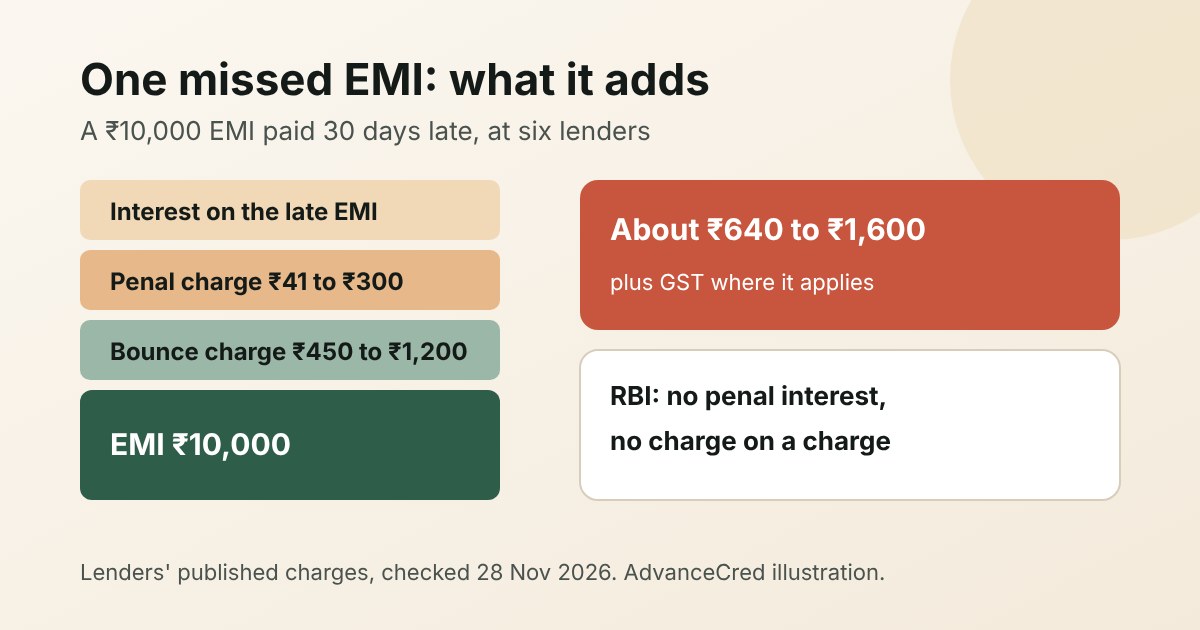
Short answer: since April 2024, RBI lets banks and NBFCs levy only a fixed "penal charge" on a missed EMI, not "penal interest" added to your rate. The charge must be reasonable, applied only to the overdue amount, never compounded, and shown upfront in your loan agreement and Key Facts Statement. RBI has set no cap, so lenders differ widely: on their own pages in November 2026, from 5% a year (ICICI Bank) to up to 36% a year (Bajaj Finance) on the overdue EMI, plus a bounce charge of ₹450 to ₹1,200.
One missed EMI is rarely expensive on its own. The trouble starts when one bounce leads to a second, the charges stack up, and the overdue days start to show on your credit report. This guide shows what lenders can and cannot charge, and what a single late EMI really costs.
What RBI's penal charges rules say
RBI's "Fair Lending Practice: Penal Charges in Loan Accounts" circular of 18 August 2023 applies to loans taken from 1 April 2024, and existing loans moved over by 30 June 2024. RBI has since carried the same rules into its Responsible Business Conduct Directions, 2025. Its purpose, in RBI's words: penal charges are "not meant to be used as a revenue enhancement tool over and above the contracted rate of interest".
| RBI rule | What it means for you |
|---|---|
| Penal charges, not penal interest | The lender cannot raise your interest rate as a penalty; it can levy a separate charge |
| "There shall be no capitalisation of penal charges" | No interest is charged on penal charges, and no penal charge on an earlier penal charge (RBI FAQs) |
| Reasonable and commensurate, without discrimination within a loan or product category | Everyone in the same loan category pays the same charge for the same default |
| Levied only on the amount under default (RBI FAQs) | The charge applies to the missed EMI, not the whole loan |
| Shown in the loan agreement, the Key Facts Statement and the lender's website | You can check the exact charge before you sign |
| Reminders must state the penal charges; any charge levied must be communicated with the reason | You should be told when a penal charge is added and why |
| No cap prescribed (RBI FAQs) | Lenders set their own level under a Board-approved policy |
| Not for credit cards | Card late fees follow separate credit card rules |
One thing the rules still allow: RBI's FAQs say lenders "may charge interest on unpaid interest (including on unpaid EMI) at the contracted rate of interest". So on top of the penal charge, you usually pay normal interest on the EMI for the days it is late.
Penal and bounce charges by lender
Checked on lenders' own personal loan charges pages on 28 November 2026. Charges change; your Key Facts Statement is the final word for your loan.
| Lender | Penal charge on the overdue EMI | EMI bounce charge | GST |
|---|---|---|---|
| ICICI Bank | 5% a year on the overdue EMI until repaid | ₹500 per cheque, auto-debit or ECS bounce | Charges exclusive of GST |
| HDFC Bank | FAQ: 1.50% a month (18% a year) on the overdue instalment after a 7-day grace period | ₹450 per instance ("payment return charges") | Taxes added |
| Axis Bank | 8% a year on the overdue amount, minimum ₹300 per instance; regular interest also charged | ₹500 per dishonoured cheque, SI, ECS or NACH | Plus GST |
| Kotak Mahindra Bank | 8% a year plus taxes; contract-rate interest also charged on the overdue EMI | ₹750 per instance, including taxes | Penal plus taxes |
| IDFC FIRST Bank | 12% a year (1% a month) or ₹300, whichever is higher | 12% of the bounced EMI, minimum ₹400, maximum ₹1,000 | No GST on penal; GST on bounce |
| Bajaj Finance | Up to 36% a year per instalment from the due date | ₹0 to ₹1,200 per bounce | Not stated |
HDFC Bank's fee table itself says only that contract-rate interest is charged on the delayed EMI, so confirm its penal figure in your KFS. SBI's Key Facts Statement template shows a penal charge of 2.40% a year for irregularity up to 60 days and 5% a year beyond 60 days on the irregular portion; it is an undated template, so check your own KFS. SBI's older "penal interest" page still says 2% a year over the applicable rate, which predates RBI's 2024 rules.
Worked example: what one late ₹10,000 EMI costs
Ravi's ₹10,000 EMI bounces because his salary came in two days late. He pays it 30 days after the due date. Charges before GST unless the lender includes it, using each lender's published figure (Bajaj Finance at its "up to" maximum):
| Lender | Penal charge (30 days) | Bounce charge | Total charges |
|---|---|---|---|
| ICICI Bank (5% a year) | about ₹41 | ₹500 | about ₹541 + GST |
| HDFC Bank (18% a year, FAQ) | about ₹148 | ₹450 | about ₹598 + taxes |
| Axis Bank (8% a year, minimum ₹300) | ₹300 | ₹500 | about ₹800 + GST |
| Kotak (8% a year) | about ₹66 + taxes | ₹750 incl. taxes | about ₹816 |
| IDFC FIRST Bank (12% a year or ₹300) | ₹300 | ₹1,000 (cap) | about ₹1,300 + GST on bounce |
| Bajaj Finance (up to 36% a year) | up to about ₹296 | up to ₹1,200 | up to about ₹1,496 |
On top of these, most lenders charge normal interest on the late EMI: at 11.60% a year that is about ₹95 for 30 days on ₹10,000. So one bounced EMI, paid 30 days late, costs roughly ₹640 to ₹1,600 with that interest (before GST where it applies), about 6% to 16% of the EMI. The bigger cost is the credit report: a payment 30 days late can show as DPD on your record for years (see what DPD on a CIBIL report means).
How a missed EMI moves from "late" to "overdue" on your record
RBI's classification of overdue loans works by days past due. Under RBI's circular of 12 November 2021, a non-revolving loan such as a personal loan is SMA-0 when overdue up to 30 days, SMA-1 from 31 to 60 days and SMA-2 from 61 to 90 days; after 90 days it can become a non-performing asset. The classification is done on the calendar date, so a payment one day late is already overdue.
When the lender reports default or DPD to the credit bureaus, RBI requires it to send you an SMS or email alert while submitting the information. That alert is not an advance warning; if you receive one, pay the overdue amount at once and keep the receipt.
What to do after a missed EMI
- Pay the overdue EMI and charges as soon as you can, even before the next due date, so the DPD stays low.
- Ask for a breakdown. RBI's rules say any penal charge must be communicated with its reason. Check it against your KFS; challenge anything not listed there.
- Stop the next bounce. If your salary date has moved, ask the lender to change the EMI date; a second bounce doubles the charges.
- Do not borrow from an app to cover the EMI. A 30-day app loan at a high cost turns one late payment into two debts; see why borrowing from one app to repay another backfires.
- If EMIs bounce because they take too much of your salary, the fix is the total EMI, not the charges. See merging multiple EMIs into one and how to reduce your personal loan EMI.
AdvanceCred's merge cases cover up to 1 payday loan, up to 5 app loans and personal loans in total, and up to 5 credit cards; the lender still decides approval, and a recent bounce can affect what a lender offers.
How AdvanceCred can help
AdvanceCred is a credit advisory and loan intermediation firm in Mumbai. It is not a lender. If EMIs are bouncing, an advisor can look at your loans, salary and credit report and tell you whether partner banks and NBFCs are likely to consider merging them into one EMI. The lender decides approval, amount, rate and tenure. See merge multiple EMIs, browse the guides hub, or leave your details below.
Sources
- Reserve Bank of India, Fair Lending Practice: Penal Charges in Loan Accounts (RBI/2023-24/53, 18 August 2023: penal charges not penal interest; no capitalisation; reasonable and commensurate, non-discriminatory within a category; disclosure in the loan agreement, KFS and website; reminders and communication; not a revenue enhancement tool; does not apply to credit cards), checked 28 November 2026: rbi.org.in
- Reserve Bank of India, Penal Charges in Loan Accounts: extension of timeline (RBI/2023-24/102, 29 December 2023: fresh loans from 1 April 2024; existing loans at the next review or renewal, no later than 30 June 2024), checked 28 November 2026: rbi.org.in
- Reserve Bank of India, Commercial Banks Responsible Business Conduct Directions, 2025 (RBI/DOR/2025-26/170, 28 November 2025, updated 1 October 2026, para 351 carries the penal charges rules; read from a published copy because RBI's PDF did not load, recheck on rbi.org.in), checked 28 November 2026: caalley.com copy
- Reserve Bank of India, FAQs on Fair Lending Practice: Penal Charges in Loan Accounts (15 January 2024: default in repayment is non-compliance; charges only on the amount under default; interest on unpaid EMI at the contracted rate allowed; no penal charges on earlier penal charges; no cap prescribed), read from FIDC's published copy because the RBI FAQ page did not load, checked 28 November 2026: fidcindia.org.in
- ICICI Bank, Personal loan service charges (penal 5% a year on the overdue EMI until repayment; ₹500 per cheque, auto-debit or ECS bounce; exclusive of GST), checked 28 November 2026: icici.bank.in
- HDFC Bank, Personal loan interest rates and charges (FAQ: 1.50% a month, 18% a year, plus taxes on the overdue instalment after a 7-day grace period; payment return charges ₹450 per instance), checked 28 November 2026: hdfc.bank.in
- Axis Bank, Personal loan interest rates and charges, and penal charge document (financial default 8% a year on the overdue amount, minimum ₹300 per instance; ₹500 per dishonoured cheque, SI, ECS or NACH plus GST; no effective date shown), checked 28 November 2026: axis.bank.in and penal charge PDF
- Kotak Mahindra Bank, Personal loan fees and charges (penal charge 8% a year plus taxes, with contract-rate interest on the overdue EMI; ₹750 per bounce including taxes; no page date), checked 28 November 2026: kotak.bank.in
- IDFC FIRST Bank, Personal loan fees and charges (12% a year, 1% a month, or ₹300 whichever is higher, no GST; bounce 12% of the EMI, minimum ₹400, maximum ₹1,000, plus GST; no effective date), checked 28 November 2026: idfcfirst.bank.in
- Bajaj Finance, All fees and charges (penal charges up to 36% a year per instalment from the due date; bounce ₹0 to ₹1,200; page metadata 24 November 2026), checked 28 November 2026: bajajfinserv.in
- SBI, Key Fact Statement for Personal Loan (template: penal charge 2.40% a year for irregularity up to 60 days, 5% a year beyond 60 days on the irregular portion; undated), checked 28 November 2026: sbi.bank.in
- Reserve Bank of India, Prudential norms on income recognition, asset classification and provisioning: clarifications (RBI/2021-2022/125, 12 November 2021: SMA-0 up to 30 days, SMA-1 31 to 60 days, SMA-2 61 to 90 days for non-revolving loans; classification on the calendar date), checked 28 November 2026: rbi.org.in
- Reserve Bank of India, Commercial Banks Credit Information Reporting Directions, 2025 (RBI/DOR/2025-26/156, 28 November 2025, updated 1 July 2026, para 34(1)(i): alerts by SMS or email while submitting default or DPD information to credit bureaus; first introduced by RBI/2023-24/73 of 26 October 2023), checked 28 November 2026: rbi.org.in
- Worked example (Ravi is an illustration, not a real customer): penal charge = ₹10,000 × annual rate × 30 ÷ 365 (5% about ₹41; 8% about ₹66; 12% about ₹99, so the ₹300 minimum applies; 18% about ₹148; 36% about ₹296); interest on the late EMI at 11.60% for 30 days about ₹95. Prepared by AdvanceCred, 28 November 2026.