Short answer: neither is always cheaper. Card EMI rates run from about 10% to 25% a year, plus a processing fee and, at several banks, GST on the interest. Bank personal loans run from about 10.25% to 24%, with GST only on the fee. For one card and a short tenure, a low card EMI rate can win. For larger dues or several cards, a personal loan at a good rate usually costs less and frees your card limits. Both are far cheaper than revolving the balance at up to 3.75% a month.
If your card bill is bigger than you can pay in full, your bank will offer to "convert it to EMI" in the app, often in two taps. A personal loan takes a little longer to arrange. The right choice depends on four numbers: the rate, the fee, GST and the tenure. Here is how they compare at the main issuers, checked on 24 November 2026.
What do banks charge for converting card dues to EMI?
Card EMI rates are set per customer, usually by credit score, inside a published range. The fee is charged once per conversion, and closing early costs about 3%.
| Issuer and product | Interest rate | Fees and GST |
|---|---|---|
| HDFC Bank SmartEMI | 10.08% to 24.96% a year; average 19.69%, APR 23.53% (July to September 2026) | Up to ₹999 + GST per booking; 3% to close early |
| ICICI Bank EMI on Call | Up to 1.5% a month (18% a year), reducing balance | Up to 2%; up to 3% to close early; GST on fee, interest and foreclosure |
| SBI Card Flexipay | 10.50% to 22% a year by score (above 780: 10.50% to 16%; 701 to 780: 16% to 18%; 700 or below: 21% to 22%) | Fee not stated in the main terms; 3% of principal to close early; 18% GST |
| Axis Bank balance on EMI | 18% a year, reducing balance | 2%, minimum ₹250; 18% GST on fees and interest |
Two costs are easy to miss:
- GST on the interest. ICICI Bank and Axis Bank state that GST applies on the interest charged, not just the fee. At 18% GST, an 18% EMI rate costs about 21.2% in effect.
- Your limit stays blocked. HDFC Bank says the total loan amount is blocked against the credit limit; SBI Card blocks the principal plus fee and GST; ICICI Bank blocks the amount of the facility. It is released only as you pay the instalments, so the card looks heavily used for months.
RBI requires card issuers to show the principal, interest and any merchant discount before the conversion and again on the statement, and EMIs that carry interest must not be sold as "no-cost". Check the screen before you confirm.
What does a personal loan cost by comparison?
| Lender | Rate | Processing fee |
|---|---|---|
| ICICI Bank | 10.25% to 16.50%, mean 11.60% (July to September 2026) | Up to 2% + taxes |
| HDFC Bank (salaried) | 10.25% to 24.00% | Up to ₹6,500 + GST |
| SBI Xpress Credit | Not shown on SBI's fee page | 1.50% (minimum ₹1,000, maximum ₹15,000) + GST |
There is no GST on personal loan interest, the loan does not block a card limit, and the money can clear several cards at once. The cost is a full credit check and a new account on your report. Our Key Facts Statement and APR guide shows how to compare offers on their all-in cost.
Worked example: ₹1 lakh of card dues, cleared in 12 months
Priya, who earns ₹55,000 a month, has a ₹1 lakh card bill after a family function. She compares four ways to clear it in about a year.
| Option | Monthly payment | Interest | Fee and GST | Total cost |
|---|---|---|---|---|
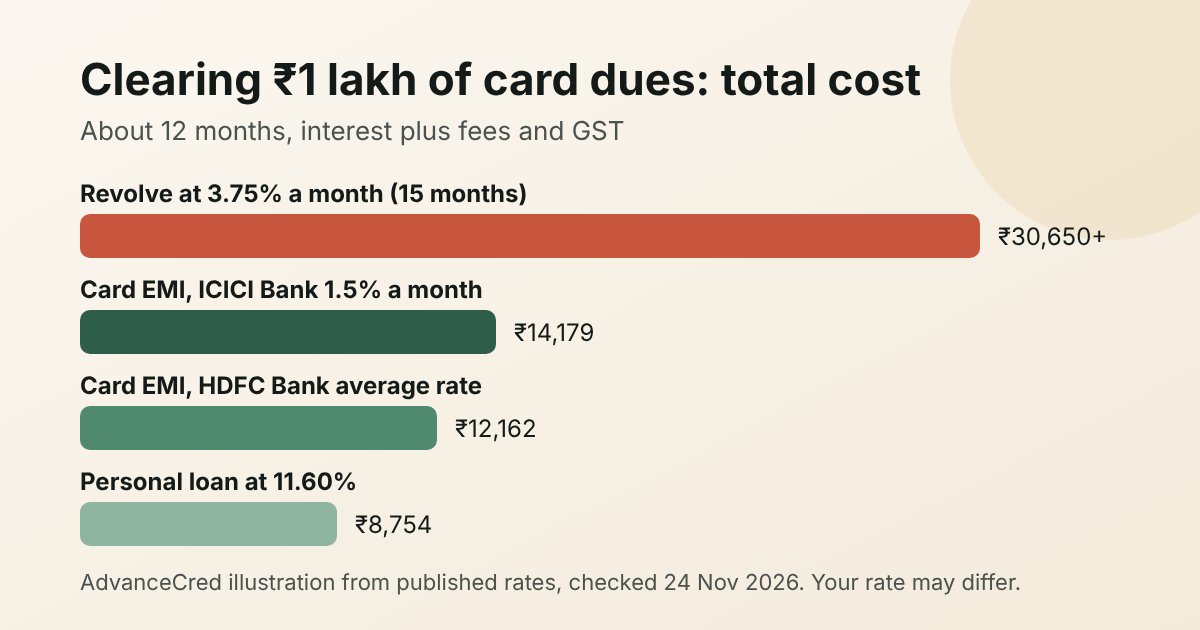
| Revolve on the card at 3.75% a month, paying ₹9,249 a month | ₹9,249 | about ₹30,650 over 15 months | plus GST on the interest | ₹30,650 or more |
| HDFC Bank SmartEMI at the 19.69% average | ₹9,249 | ₹10,983 | ₹999 + GST = ₹1,179 | ₹12,162 |
| ICICI Bank EMI on Call at 1.5% a month | ₹9,168 (before GST) | ₹10,016 + ₹1,803 GST | 2% + GST = ₹2,360 | ₹14,179 |
| Personal loan at 16.50% (ICICI Bank's top rate) | ₹9,097 | ₹9,161 | 2% + GST = ₹2,360 | ₹11,521 |
| Personal loan at 11.60% (ICICI Bank's mean) | ₹8,866 | ₹6,394 | 2% + GST = ₹2,360 | ₹8,754 |
What this shows:
- Any EMI beats revolving. Paying the same ₹9,249 a month on a revolving balance takes 15 months and costs about ₹30,650 in interest before GST, two and a half times the card EMI.
- On ₹1 lakh for a year, the gap between a card EMI and a personal loan is small, about ₹600 to ₹5,400 here. A card EMI near the bottom of its range (HDFC Bank from 10.08%, SBI Card from 10.50% for scores above 780) can beat a personal loan, because the fee is lower.
- The gap grows with the amount and the tenure. Over 24 months, the same ₹1 lakh costs about ₹19,800 of interest at 18% before GST, against about ₹12,500 at 11.60%.
Worked figures use the standard reducing-balance formula. Your rate depends on your credit score, income and relationship with the bank.
When is a card EMI the better choice?
- One purchase or one card, a modest amount and 3 to 12 months.
- You are offered a rate near the bottom of the range, or a merchant's genuine no-cost EMI.
- You need it today and a personal loan would take longer.
- You will not use the card again until the EMI is paid off, so the blocked limit does not matter.
When is a personal loan the better choice?
- Dues on two or more cards, or a card balance plus app loans. One loan replaces them all and frees every card limit.
- Larger amounts or longer tenure, where a lower rate and no GST on interest add up.
- Your card utilisation is high. A blocked limit keeps it high; paying off the cards with a loan brings it down. Our guide on the minimum due trap explains how card balances weigh on your score.
- You keep converting new bills to EMI every month. That is a sign of a cash-flow gap, not a one-off bill, and stacking EMIs on one card makes it worse.
If several cards are involved, our credit card debt consolidation page works through a ₹2 lakh, three-card example, and what to do with a big card bill after a festival covers statement dates and timing.
Before you convert: a checklist
- Check the rate on the confirmation screen, not the "starting from" rate in the offer.
- Ask whether GST is charged on interest as well as the fee.
- Note the processing fee and the foreclosure charge (about 3%).
- Remember the limit stays blocked until the EMIs are paid.
- Compare with a personal loan's APR for the same amount and tenure.
How AdvanceCred can help
AdvanceCred is a credit advisory and loan intermediation firm in Mumbai. It is not a lender. If your card dues are spread across several cards or mixed with app loans, an advisor can compare a single personal loan from partner banks and NBFCs against converting each card, on total cost. AdvanceCred works on cases with up to 5 credit cards, up to 5 app and personal loans in total and up to 1 payday loan. The lender decides approval, amount, rate and tenure.
Try the loan-merge checker, browse the debt consolidation guides hub, or leave your details below.
Sources
- HDFC Bank, SmartEMI (rates from 10.08% a year; July to September 2026 table: minimum 10.08%, maximum 24.96%, average 19.69%, APR 23.53%; fee up to ₹999 + GST per booking; 3% pre-closure; total amount blocked against the credit limit), checked 24 November 2026: hdfc.bank.in
- HDFC Bank, Credit card MITC, version 2.3, October 2024 (3.75% a month, 45% a year on most cards, from 1 August 2024), checked 24 November 2026: hdfc.bank.in
- ICICI Bank, EMI on Call (up to 1.5% a month on reducing balance; fee up to 2%; foreclosure up to 3% plus interest and GST), checked 24 November 2026: icici.bank.in; terms and conditions (GST on processing fee, interest and foreclosure; credit limit blocked): icici.bank.in; credit cards page (maximum charge 3.75% a month): icici.bank.in
- SBI Card, Flexipay terms (10.50% to 22% from 1 December 2024, by bureau score; 3% foreclosure plus taxes; 18% GST; limit blocked up to principal + fee + GST), checked 24 November 2026: sbicard.com; Flexipay FAQ (no foreclosure fee if cancelled within 30 days): sbicard.com; MITC (up to 3.75% a month, 45% a year): sbicard.com
- Axis Bank, Balance on EMI (18% a year reducing balance; fee 2%, minimum ₹250; 18% GST on fees and interest; page dated 2024, so check the current offer), checked 24 November 2026: axis.bank.in
- ICICI Bank, Personal loan interest rates (July to September 2026: 10.25% to 16.50%, mean 11.60%; fee up to 2% + taxes), checked 24 November 2026: icici.bank.in
- HDFC Bank, Personal loan interest rates and charges (salaried 10.25% to 24.00%; fee up to ₹6,500 + GST), checked 24 November 2026: hdfc.bank.in
- SBI, Processing fees (Xpress Credit 1.50%, minimum ₹1,000, maximum ₹15,000, + GST; last updated 12 October 2026), checked 24 November 2026: sbi.bank.in
- Reserve Bank of India, Master Direction – Credit Card and Debit Card – Issuance and Conduct Directions, 2022, para 6(b)(iii) (principal, interest and discount shown before EMI conversion and on the statement; interest-bearing EMIs not to be shown as no-cost), checked 24 November 2026: rbi.org.in
- Worked example (Priya; 19.69%, 18%, 16.50% and 11.60% applied to ₹1 lakh over 12 months, revolving at 3.75% a month with the same payment): standard reducing-balance formula, calculated by AdvanceCred, 24 November 2026.